Last updated: 2026-09-20
A city of highways versus a street of sixteen houses
A graphics chip is a city with a huge postal system. Cores do not need a private wire to every other core. They ship numbers through memory. That is why a dense table of numbers works there. Sparse tables — mostly zeros — do not make that city a hundred times faster. The zeros still cause awkward memory trips.
The cheap sampling chip is the opposite geometry. It is a grid of probabilistic bits: tiny circuits that behave like weighted coin flips. Each one is wired, in silicon, to sixteen neighbors. Those wires are the whole conversation. There is no all-to-all memory highway. The chip sits in a programmable energy landscape and repeatedly lets each coin look at its neighbors and flip. That happens in place, at more than fifty million updates a second, for less than a watt, on a die smaller than twelve millimeters on a side. About a quarter million of these coins live on one chip.
Extropic’s Z1 is a 2026 instance of that street. Naming Z1 is not a valid invent. The invent is a local use of the category.
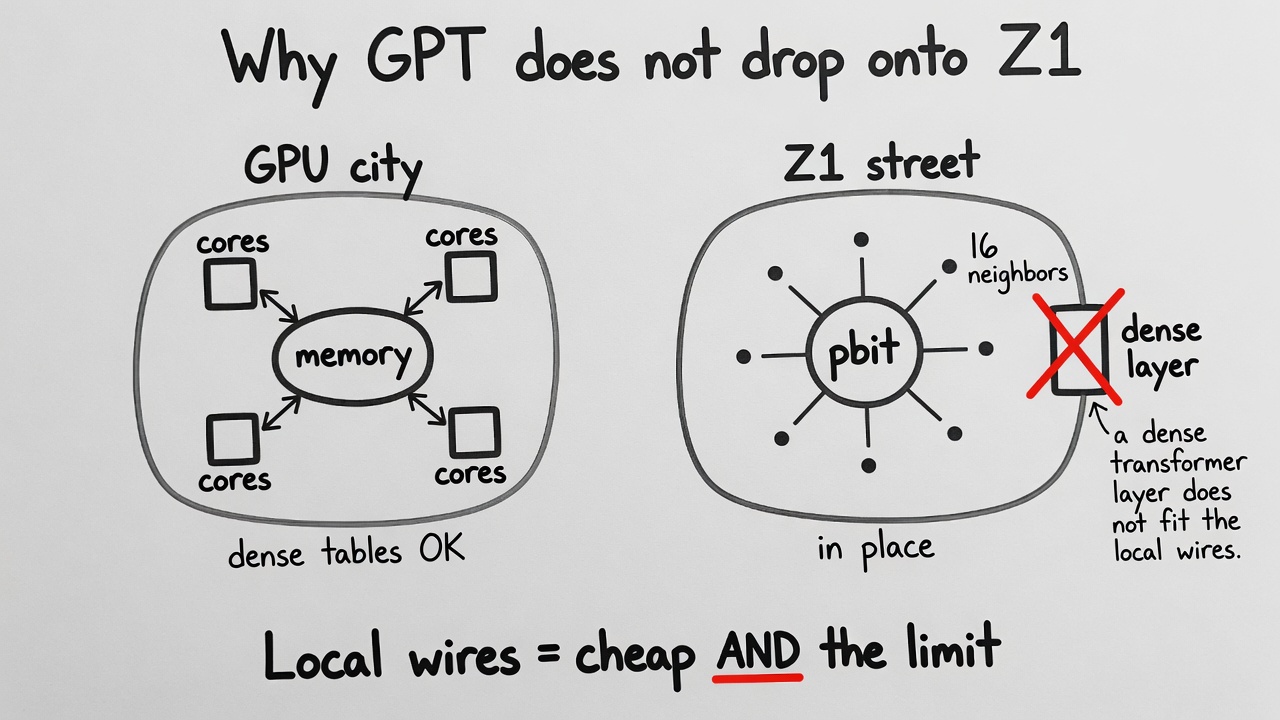
Local wires are why the chip is cheap. They are also a hard limit. If your layer needs every output to see every input, the layer does not fit.
You cannot copy a dense writing model onto that street and press go.