Last updated: 2026-08-20
What a small drone can do today
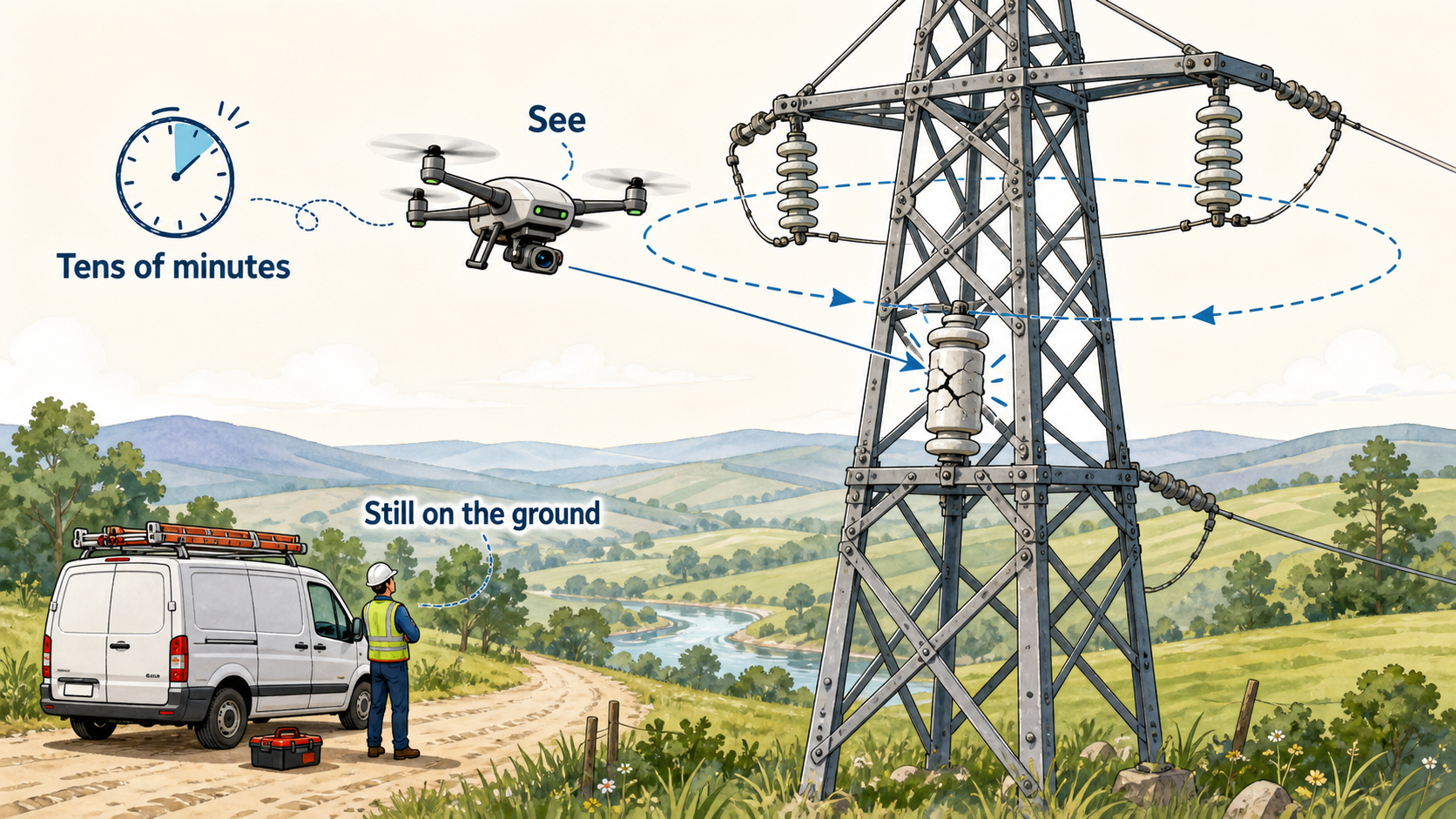
A utility worker used to climb every tower. Now a docked camera ship can launch on a ticket, fly a learned orbit, and flag a cracked insulator — when weather and airspace allow. The coffee is still warm. The van is still in the yard for the repair.
Small sensing drones — camera and inspection multirotors, grams to tens of kilograms — are the product category that got cheap. They hover, carry a camera or a thermal imager, and map a roof, a line, or a field on a flight measured in tens of minutes and a few kilometers under visual-line-of-sight rules. Beginner kits sell in the hundreds of dollars; strong camera kits around one to two thousand; enterprise airframes climb into five figures.
They are good at seeing. They are weak at going far while hovering. Pure multirotor endurance is often twenty to forty-five minutes. Fixed-wing and hybrid designs fly hours because wings carry the weight. Heavy lift and passenger seats are different categories, with different prices and rule books.
Name what this category can do now, or the next page’s limits will sound like nitpicking.
The tempting mistake is to treat a working tower orbit as proof that vans, helicopters, and driveway flying cars are already obsolete. A photo is not a logistics network.
That is what lets you see the stack that still blocks a city fleet.