Last updated: 2026-08-20
Not a tiny electric helicopter
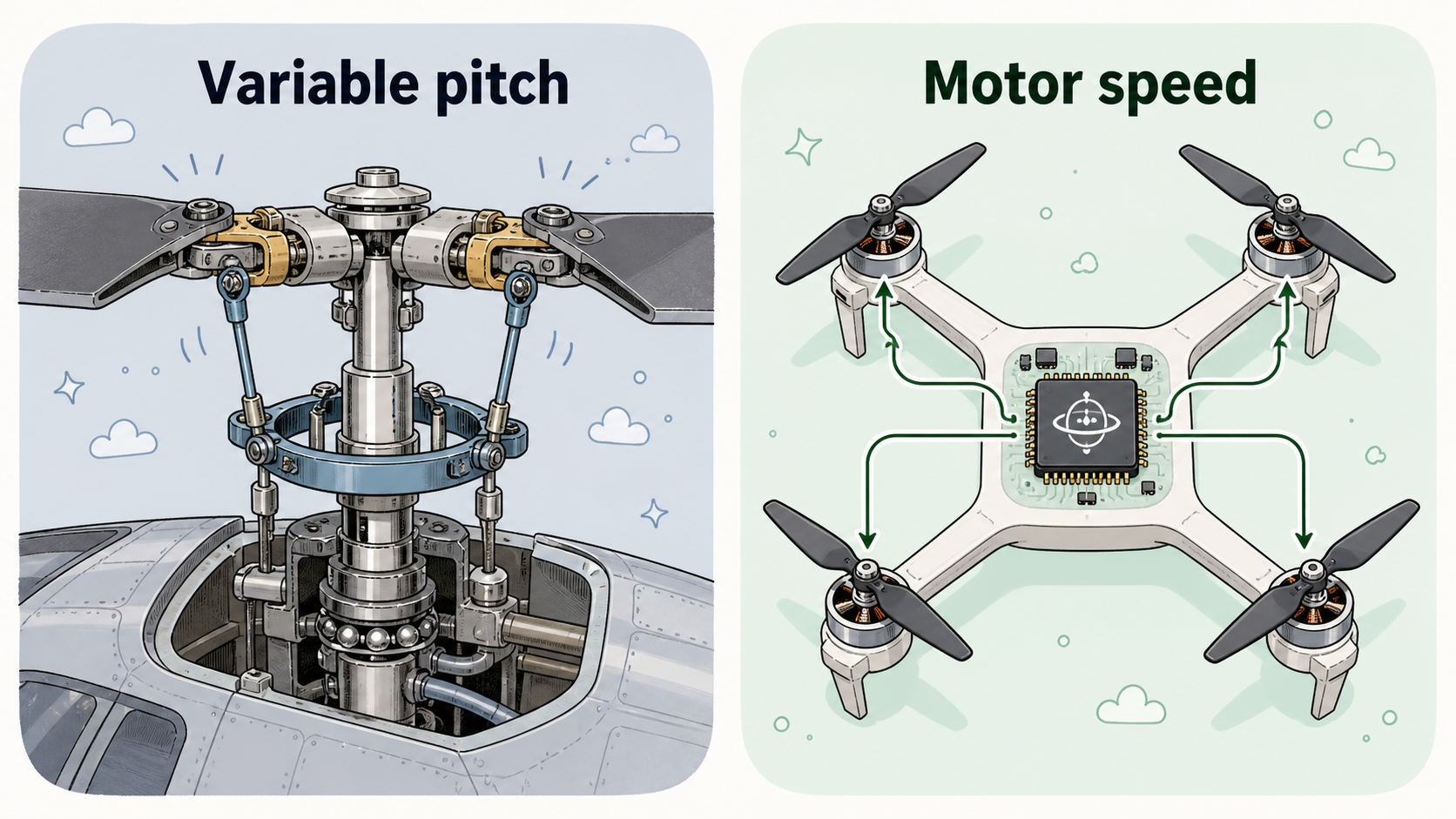
A classic helicopter tilts its blades through a swashplate — a precision machine of bearings and linkages. A holiday-catalog quadcopter has no such head. Each propeller is a cheap molded disk. The computer does the flying.
A conventional helicopter uses variable pitch: blade angle changes many times per revolution. A typical multirotor uses fixed-pitch props and steers by changing motor speed thousands of times per second. Tiny inertial sensors and a flight computer replace the mechanical cleverness. Digital bandwidth substitutes for metal.
That swap is why consumer drones became cheap. Variable-pitch heads are lifetime machines. Once phones drove sensor cost toward cents, and batteries plus brushless motors rode the same electronics curve, a stable hover became a bill of materials, not a rotorcraft apprenticeship.
The same swap is why small multirotors still lose at large scale. Hovering on small rotors is power-hungry. Endurance is often tens of minutes. Passenger machines grow wings or bigger disks because the toy architecture does not scale into an airliner.
The tempting mistake is to call a quadcopter a miniature helicopter because both hover. Hover is shared. Control and price are not.
That is what lets you name what a small sensing drone can actually do today.