A tech primer
Typed Decisions, Not Chat
Jev by TypeSafe AI — what shipped, which claims survive the footnotes, and what an inspectable audit trail actually is.
Last updated: 2026-09-16
Paper type: For noting.
As of: 17 September 2026.
This paper does not recommend a purchase, a build, or a pause. It states what is on the public record one day after TypeSafe left stealth.
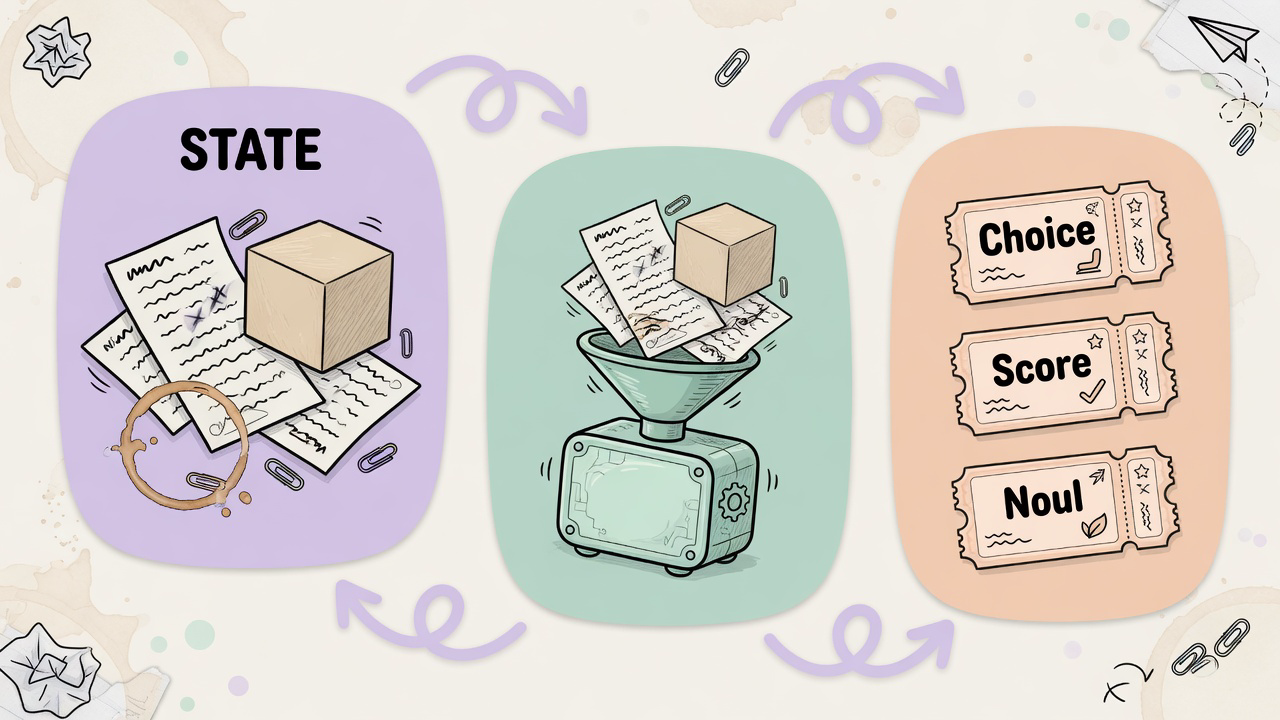
Jev is TypeSafe AI’s first public System One model. The introduction on docs.typesafe.ai states the mismatch first: large language models are designed to produce text for humans to read. When code needs a judgment, you are coercing a text generator into structured decisions and then parsing. Jev evaluates typed questions against a state and returns structured results directly. No text generation, no parsing. You get typed values and probability distributions that your code can branch on, sort by, and route with.
Early access opened 15 September 2026. The HTTP call is POST https://api.typesafe.ai/v1/systemone with model alias jev-latest. List price on the launch post is $0.042 per million input tokens and $0 output, which TypeSafe calls “too cheap to meter.”
The founder, Diogo Almeida, is a starred primary author of the 2022 InstructGPT paper (the OpenAI work that trained GPT-3 to follow instructions with human feedback). He is not the sole inventor of ChatGPT. Cofounders named on the team page are Erik Gafni (CTO) and Sasha Sheng (COO). DCVC led a $40 million seed announced the same day as the model. A Forbes article the same day put post-money at $200 million according to a person familiar with the deal. That valuation is one anonymous source.
What the introduction documents as the product
TypeSafe exposes three AI primitives. The introduction’s table is the contract:
| Question type | Goal | Returns |
|---|---|---|
| Choice | Choose an option from a list | choice, probabilities, confidence |
| Score | Score the state on a rubric | score, probabilities, confidence |
| Noul | Is this statement true? | noul (0–1) |
Noul is the true/false primitive. The docs do not define the word as a blend of “no” and “null.” They define the job: is this statement true, answered with a probability from 0 to 1. Near 1 is a strong yes. Near 0 is a strong no. Near 0.5 means yes and no look similar; it is not “medium skill.” There is no separate confidence field on a Noul. The instruction can be a question or a statement evaluated for truthfulness.
All three types can be mixed in one call. Every question is evaluated in parallel and in isolation against the same state. Adding questions barely changes response time. Each question is independent, so adding more does not create context-rot.
The introduction’s composition rule: keep each question a gut-check — something a knowledgeable person could decide in a few seconds with the right context. If the judgment would take extended reasoning or mixes independent factors, split it and combine in code. Their example: instead of “rate this startup pitch,” ask market size, technical feasibility, and differentiation separately, then apply your own formula so a priority change is a coefficient, not a rewritten prompt.
What the cookbooks run
The console path console.typesafe.ai/docs/cookbooks is a login wall. The same notebooks are public on docs.typesafe.ai. They are worked examples, not independent evals. A sample of what they measure:
- Parallel questions. Thirteen checks on the GDPR Wikipedia article (~54,000 characters), one batched call versus thirteen singles: 12.2× cheaper and 10.0× faster, answers unchanged. That is batch-Jev versus unbatched-Jev, not Jev versus a frontier LLM. The notebook pins
jev-1.12. - Re-ranking. BM25 shortlist of 30 court-opinion passages, 40 CLERC queries, then one TypeSafe question per pair. Top-1 5% → 18%; top-10 38% → 62%.
- Skill suggestion. 182 Hermes skills. One request ranks the roster and asks whether a skill is needed at all; a second re-reads the top three in full and can reject all of them. TypeSafe says wrong skill-loads drop by more than half.
- Guardrails. One request on the way into an LLM and on the way out: Nouls for hazards such as jailbreak, plus a Score for harm. Your code thresholds pass / review / block / support. “Ignore your instructions” is scored as a jailbreak instead of working as one.
- Citations. One Choice per quote against the source document (supports / says nothing / contradicts); confidence can auto-accept or send to a human.
- Dates and numbers. Date-extraction and pre-parsed-value cookbooks put parts or regex candidates through Jev, then resolve in code — the same split as the jaggedness page.
None of these notebooks ask Jev to write a rationale. The trail is still the questions, the numbers, and the branch in code.
Jaggedness, jev-1.13, last reviewed 17 September 2026. TypeSafe’s own limit list: literal reading, counting, math, date comparison, indirection, large irrelevant state, adversarial content, contradictory instructions versus criteria, and generation (use a generative model). Do arithmetic and date order in code. Do not interpolate a Score between levels to reconstruct a precise magnitude. State is not treated as hostile by default.
What the launch claimed, and what the same blog already hedged
TypeSafe’s launch post says “Extraordinary claims require extraordinary evidence.” The X thread led with 20–200× faster and 40–400× cheaper. The blog under the thread is narrower.
Speed. Vendor end-to-end band is 70–500 milliseconds against 3–329 seconds for “frontier” calls, with evals generally run from West Coast laptops because that is where the service sits. The homepage pair 193.6× faster / 444.6× cheaper is taken from TypeSafe’s own workflow evals; the blog says those figures are “on the higher end of real world gains,” and that the workflows were built by the company’s model-capabilities team, so “some bias could exist.”
Price. The $0.042 / MTok input number is on the price sheet. TypeSafe writes, of that sheet: “We can’t prove it isn’t subsidized; we’ll need the long-term to prove the sustainability of our pricing (which we expect to go down, not up).”
Hallucination. Homepage copy says “Zero Hallucinations.” The launch post’s nuance box says the 0% bar “is not empirical. Schema matching is guaranteed, thus we can confidently add 0% into the plots.” That is a closed output set: Jev cannot emit a tool name or a class that was not in the question. It can still pick the wrong class. TypeSafe’s own docs say calibration does not guarantee that an individual answer is correct.
Intelligence. The pitch is “similar levels of intelligence on System One tasks” compared with existing LLMs. The evaluation TypeSafe published does not use human ground truth. It uses the average of GPT-6 Astra and Claude Fable 5.1 as the reference, on four internal workflows (security incidents, agent traces, invoices, customer service). Secondary reading of that dashboard (OrcaRouter, 16 September 2026) puts Jev around 67.8% mean agreement against 74.1% for the best comparator: cheaper and faster, not more accurate. TypeSafe also notes that forcing LLMs through its structured wrapper is slower and more expensive than asking them for a decision without probabilities, which paints Jev in a favorable cost/latency light.
Architecture. The company says it rebuilt the model, the sampler, and the trainer (RLCD, Reinforcement Learning for Calibrated Decisions). There is no paper, no parameter count, and no public weights. Sean Goedecke’s 16 September 2026 essay argues that prefilling a normal language model and emitting one constrained token already buys most of the speed, and that “can’t hallucinate” is a semantic dodge. That replica is the live technical objection. It does not make Jev fake. It makes “new architecture family” unproven.
Demos. Doom at about ten calls per second and about $7/hour is, in TypeSafe’s own nuance box, a bot over structured text state, “not on images (yet…),” and “a non-AI doom bot could play better.” Wikiracing uses a two-stage score-then-choose pattern once cardinality exceeds 255 options.
Independent measurement in the first day
Mike Taylor at Every (15 September 2026) ran Jev over 27 of his articles plus 10 AI-styled counterparts, 21 questions each: 777 judgments in under 0.7 seconds, about a quarter of a cent. A second small test against planted writing defects was about 25× faster and about 1/580th the cost of Claude Fable 5.1 at high effort, and missed one of seven defects that Fable caught. That is the entire independent accuracy record as of this paper. It is enough to treat latency and list price as real. It is not enough to treat accuracy as frontier-equal.
X and Community Notes
The launch went out from Almeida’s personal account @CompleteSkeptic. A tracker (Doomers) recorded very high view count on that thread. No X Community Note was found on the main launch posts as of 16 September 2026. Notes often lag a 24-hour-old viral post; absence is not clearance.
What the first-day crowd actually argued, in substance rather than in likes: Jev is not a general chat model; “no hallucination” is being redefined as “no illegal string”; the price may be seed-subsidized; a prefill replica may clone the speed without TypeSafe’s unpublished net. A Hacker News comment from an account identifying as a TypeSafe employee said Jev is not a reasoning model and that reasoning should live in code. That employee frame matches the public docs.
All-In and Moonshots episodes available through 11 September 2026 predate the 15 September launch. There is no podcast confirmation of this SKU.
How the object sits in software
Jev is a model. From a harness’s point of view it is also a tool (ask a typed question, get a number, branch). It is not a harness: it does not run a loop, a sandbox, or other tools. TypeSafe’s own “how to build” page wants code to own control flow and side effects, with System One inserted only at narrow semantic judgments. Community glue such as pi-jev uses it as a gate on bash/write/edit. Confidence bands (act / confirm / escalate) live in the caller’s code. Noul answers do not even carry a separate confidence field; the probability is the signal.
State you send is the document that leaves your boundary. Public docs reviewed for this paper do not include a residency table, a zero-data-retention row, or a DPA. The service is described as US West Coast. jev-latest is the documented alias; a silent alias move would move every threshold you tuned.
Automated decisions and an explainable audit trail

Jev can sit in an automated decision path. It does not, by itself, produce a natural-language explanation. That split is in the product contract, not an oversight.
Automation. The documented job is software that acts: send state plus typed questions; get a Choice (choice + probabilities + confidence), a Score (score + probabilities + confidence), or a Noul (noul 0–1 only); branch, score, or route in code. TypeSafe’s pattern is three bands — act, confirm, escalate — with the cutoffs in the caller’s program. Noul has no separate confidence field; the 0–1 probability is the signal. That is automated decision-making with a human-in-the-loop gate, not a chatbot that narrates a plan.
The remaining error class is wrong-but-typed. Calibration is defined across a group of predictions; it does not guarantee a single answer. Unattended high-stakes use is only as honest as those probabilities on the caller’s own labeled set.
What “explainable” Jev actually returns. TypeSafe’s docs state that System One models do not write replies, produce code, or generate explanations of their reasoning. A Hacker News comment from an account identifying as a TypeSafe employee said the same thing: put reasoning in code. Jev will not emit “because clause 4.2 and the receipt don’t match.”
What a caller can persist as a trail, because it is already structured:
| Field logged | What a later reviewer can see |
|---|---|
state |
The exact document judged |
Question instructions plus criteria / options |
The policy that was asked, in the caller’s words |
choice / score / noul |
The decision |
Full probabilities |
Alternatives the model did not pick |
confidence (Choice and Score only) |
How peaked that distribution was |
model (jev-latest unless pinned) |
Which SKU answered |
| The program’s action and threshold | Why the system paid, held, or paged a human |
That record is inspectable: what was asked, over what options, what numbers came back, what the program did. It is not a rationale. Confidence 1.0 means the probability mass sat on one option. TypeSafe says that describes the answer, not that the answer is correct.
How a fuller trail is assembled. Split one fat judgment into atomic questions and combine them in code (composite scoring, confidence-gated routing). The composition is then the audit story: for example, Noul “duplicate charge?” = 0.97; Choice “team” = returns at 0.60 and billing at 0.38, confidence 0.39 → hold and review. TypeSafe’s citation-check cookbook uses Jev the other way: to judge an LLM’s citations (verified / unsupported / contradicted / fabricated), not to author the explanation.
What is not in the product. No chain-of-thought, no “why” string, no feature-attribution trail, and no published logging, retention, or DPA so the vendor side of an audit is still the caller’s to design. jev-latest can move under a tuned threshold unless the alias is pinned.
Jev can therefore give a replayable, typed ledger on an automated path. If an auditor needs “why” in sentences, that text has to come from the questions, the rules, and a human — not from Jev.
Facts / Trends / Bets / Warnings
Facts
| Fact | What it is not | |
|---|---|---|
| Jev early access 15 Sep 2026 | TypeSafe launch blog; DCVC same day | General availability |
| Three primitives only | Docs introduction: Choice, Score, Noul. Noul = “Is this statement true?” → noul 0–1 |
A JSON-document generator; a defined etymology for the word “Noul” |
| $0.042 / MTok input, $0 output on the launch sheet | Launch blog | Proof the meter is unsubsidized |
| $40M seed led by DCVC | DCVC; FinSMEs | The $200M Forbes figure |
| Almeida starred on InstructGPT | arXiv:2203.02155 | Sole inventor of ChatGPT |
| No Community Note found 16 Sep 2026 | X search this pass | A Note cannot appear later |
| System One does not generate explanations of reasoning | Docs: System One | A natural-language rationale / chain-of-thought |
Choice/Score return full probabilities plus confidence; Noul returns only noul |
API reference; Confidence page | A vendor-hosted audit log |
Trends
| Trend | Metric | Classification |
|---|---|---|
| Closed-set inference getting cheap | Jev list price vs chat/reasoning output tokens | Stepwise product on a longer cheap-classifier curve, not a published doubling-time exponential |
| Judges inside agent loops | pi-jev, Every’s “check the agent as it goes” | Measured in demos, not yet a market series |
| Public benches losing trust among some labs | Almeida anti-bench essay, 11 Sep 2026 | Take, not a measured decline in bench use |
Bets
| Bet | Holder | Falsifier |
|---|---|---|
| Cheaper intelligence increases total use (Jevons); TFP +3% in five years | TypeSafe manifesto | TFP does not move; usage stays in copilots |
| RLCD makes probabilities honest enough to automate | TypeSafe / Almeida | Buyer reliability diagrams sit off the diagonal |
A lab ships Terra-System-One and eats the interface |
Goedecke (wish, not a timed bet) | No lab SKU, or TypeSafe’s unpublished net still wins the eval |
Warnings
| Item | Kind |
|---|---|
| Homepage 193.6× / 444.6× without the blog’s “high end / our team built the workflows” box | Marketing vs footnote |
| “Zero hallucinations” heard as “never wrong” | Error-class swap |
jev-latest plus tuned thresholds |
Model-continuity |
| US-hosted closed API on a live customer decision | Data-boundary / registry row for the use, not for the vendor slogan |
| Seed-era prices | Vendor says it cannot prove they are not subsidized |
How to see this in your own books
This is observational, not a vendor pick. If invoices already show spend on chat completions used only to emit a label (route this ticket, is this fraud, did the agent’s patch look safe), those lines are the comparison class Jev is priced against — not the lines that pay for code generation or long reasoning. If a named group already runs a classifier or grammar-constrained decode for the same labels, that is the replica Goedecke described, and it is the control any later Jev trial would have to beat on your labeled set, not on TypeSafe’s Astra/Fable agreement plot.
Watch list
| Date / gap | What would change the record |
|---|---|
| Architecture paper / params / weights | Moves “new architecture” out of slogan |
| Public reliability diagram on a non-vendor set | Moves RLCD out of product-name |
| Twelve-month price sheet | Tests the subsidy hedge |
| A Community Note on the launch thread | Tests whether X’s crowd-correction layer ever attached |
| All-In / Moonshots after 15 Sep 2026 | First podcast-signal pass that can actually mention the SKU |
| Second independent accuracy study larger than Every’s 7-defect sample | The accuracy claim is still almost entirely vendor-side |
Residency, DPA, jev-latest changelog |
Enterprise control-plane gaps |
| Vendor-side audit log or “why” field | Not on the public API; trail is what the caller persists |
Sources
Research appendix (this site)
- Research appendix home
- Research index
- What Jev is
- Architecture and RLCD
- Claims audit
- Company and founder
- Evals and accuracy
- API and audit trail
- Contrarian
- Taxonomy
- Vendor risk
- Cookbooks
- Question ledger
- External primary sources
Primary sources
- Introducing System One Models & Jev
- TypeSafe docs
- DCVC seed note
- InstructGPT
Full dossier
Nine research chapters, the claims audit, sources, and the master question ledger behind this primer.
Pick a real place. Use what this essay made possible. You lead.