Research · Typed decisions, not chat
What Jev is
Last updated: 2026-09-16
The product that shipped on 15 September 2026
❓ What did TypeSafe actually put on the public internet, and what class of software is it?
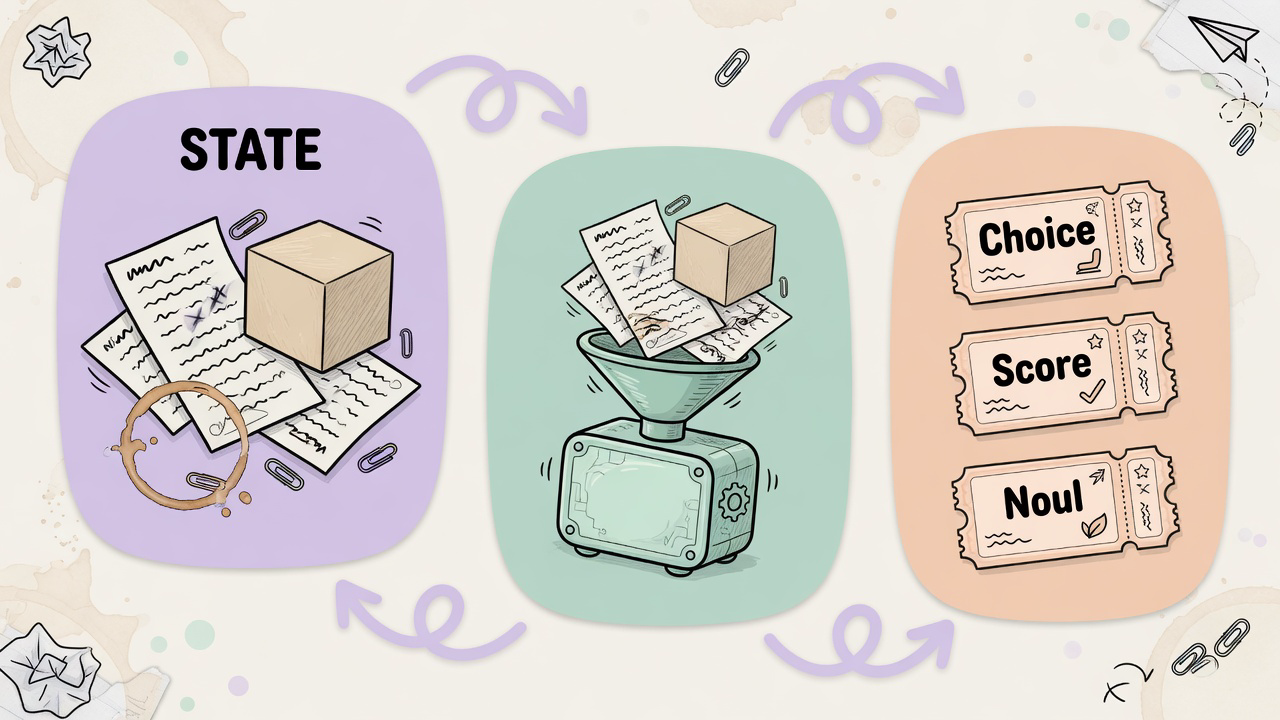
On 15 September 2026, TypeSafe AI opened early access to Jev, which it calls the first public System One model.[1] A System One model, in TypeSafe’s own definition, is a model that reads unstructured state (a message, a JSON object, a slice of application memory) and returns typed decisions that software can branch on, rather than generating a string for a person to read.[7]
The official one-line pitch on the launch post is: treat Jev as a “frontier-intelligence function call: unstructured state in, typed probabilistic decisions out.”[1] The homepage restates the same idea as “the first (public) System One Model; Jev gives AI the properties of code.”[2]
Jev is not a chatbot, a coding model, a reasoning model with hidden thinking tokens, or a local/open-weight download. TypeSafe’s documentation states that System One models “do not write replies, produce code, or generate explanations of their reasoning.”[7] Access on launch day is a waitlist plus a browser playground; the callable alias is jev-latest on POST https://api.typesafe.ai/v1/systemone.[10][11]
The name Jev is after William Stanley Jevons, not a person on the team. TypeSafe expects cheaper intelligence to increase total use, the way more-efficient steam engines increased coal demand.[1] System One is borrowed from Daniel Kahneman’s Thinking, Fast and Slow: fast, focused judgments rather than slow deliberation. TypeSafe itself notes that “System 1 thinking” has also implied error-prone, and says it will argue later that System One models can be made more reliable than the alternatives.[1]
Diogo Almeida opened the launch on his personal X account @CompleteSkeptic rather than from @typesafeai. The post led with the InstructGPT/ChatGPT credential, then the two years in stealth, then three checkable speed/cost bullets. Doomers later ranked that thread among the highest-reach launches it tracks for 15 September 2026.[1][40]
The three primitives
❓ What can Jev actually return, and why is there no fourth “JSON blob” primitive?
Every request evaluates one state against a map of questions. TypeSafe’s introduction states the contract in one line: send state and typed questions; get structured answers your code can use directly. No text generation, no parsing.[6]
All three question types can be mixed in a single API call. Every question is evaluated in parallel and in isolation against the same state. Adding questions barely changes response time. Because each question is independent, adding more does not create context-rot (later questions going stale because the prompt got longer).[6]
There are exactly three question types. The jobs below are the docs’ own wording:[6][12][13][31]
| Question type | Goal (docs) | Returns |
|---|---|---|
| Choice | Choose an option from a list | choice, probabilities, confidence |
| Score | Score the state on a rubric | score, probabilities, confidence |
| Noul | Is this statement true? | noul (0–1) |
Noul is not defined as a portmanteau in TypeSafe’s documentation. The introduction gives only the job: a true/false statement, answered with a single probability that it is true.[6] The Noul page adds: near 1 is a strong yes, near 0 a strong no, near 0.5 means yes and no look similar — it does not mean “medium.” There is no separate confidence field.[31] You may phrase the instruction as a question or as a statement to evaluate for truthfulness.[31]
The introduction’s composition rule: each question should be a gut-check — a judgment a knowledgeable person could make in a few seconds with the right context. If the thing you want would take extended reasoning or mixes independent factors, split it, ask each factor, combine in code. Example they give: instead of “rate this startup pitch,” ask market size, technical feasibility, and differentiation separately, then apply your own formula so a priority change is a coefficient, not a rewritten prompt.[6]
Choice options are capped at 255 per field. For higher cardinality (the Wikiracing demo’s hundreds-to-thousands of Wikipedia links), TypeSafe documents a two-stage pattern: score candidates independently, then choose.[1][19]
There is no fourth primitive for “emit a JSON document of whatever shape.” JSON in the API is the envelope. The model’s output values are the three typed answers. That is the constitutive difference from OpenAI Structured Outputs, grammars, or “JSON mode,” which still generate tokens that happen to parse.[18]
What Jev is not
❓ Which nearby product categories would a reader confuse this with in the first week?
- Not a smaller LLM that chats. Homepage FAQ asks “Is Jev just a smaller LLM?”; the accordion body is client-rendered and was not in the static HTML on 16 September 2026. The docs answer the substance: it understands natural language on the way in and refuses string generation on the way out.[7][2]
- Not a reasoning model. A Hacker News comment from an account identifying as a TypeSafe employee said Jev “isn’t a reasoning model, it doesn’t have hidden thinking tokens,” and framed explicit reasoning as something the surrounding code should own.[38]
- Not pixels-in. The Doom demo consumes a structured text/data representation of game state, “not on images (yet…).”[1]
- Not GA. Early access, waitlist, US-hosted service. No public GA date, no published SOC/DPA/residency table in the docs index reviewed on 16 September 2026.[6][14]
- Not a harness. Jev does not run a loop, a sandbox, or tools. It is a model you call from a harness or from ordinary application code. See 06-stack-and-api.
Why this is a good explanation
❓ What is hard to vary here, and what would falsify it?
The hard-to-vary claim is the output contract, not the unpublished weights. If Jev emitted free-form text, the speed, the $0 output meter, and the “can’t hallucinate a tool name” chart would all have to be rewritten. If it only classified among a closed set, those three properties follow from the interface even before anyone discusses RLCD. That is testable: one counter-example of a generated sentence, or of a Choice value not in the supplied list, would falsify the contract. TypeSafe says the latter is “mathematically impossible.”[1]