Research · Create / destroy
Fiat entropy
Last updated: 2026-07-30
Base vs broad money
❓ How is fiat actually created and destroyed?
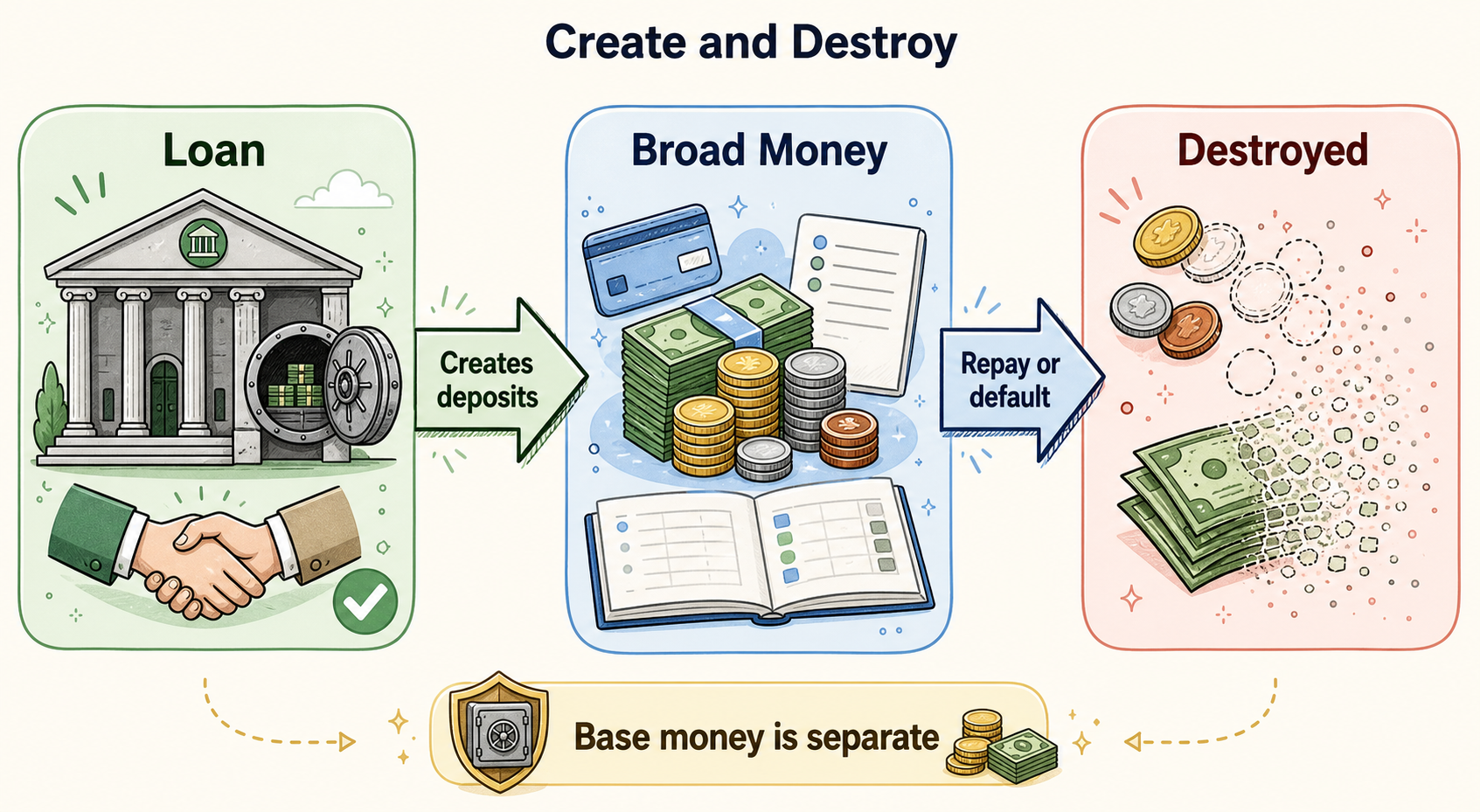
Base money (monetary base): currency in circulation plus commercial bank reserves at the central bank—a direct central bank liability.
Broad money: mainly bank deposits and close substitutes held by the public.
In the US-centric account (Chapter 15), deposits largely expand when banks make loans (and related operations) and contract when loans are repaid or written off—subject to regulation, capital, and reserve regimes. Base money expands when the central bank buys assets or lends (including QE-era expansions) and can shrink with QT or reverse flows.
Alden cites: Fed founding-era base ~$2.79B and broad ~$19.31B (1913) versus end-2022 base ~$5.4T and broad ~$21.4T—orders-of-magnitude growth in the claim system.
Why entropy
❓ Why call this entropy rather than healthy elasticity?
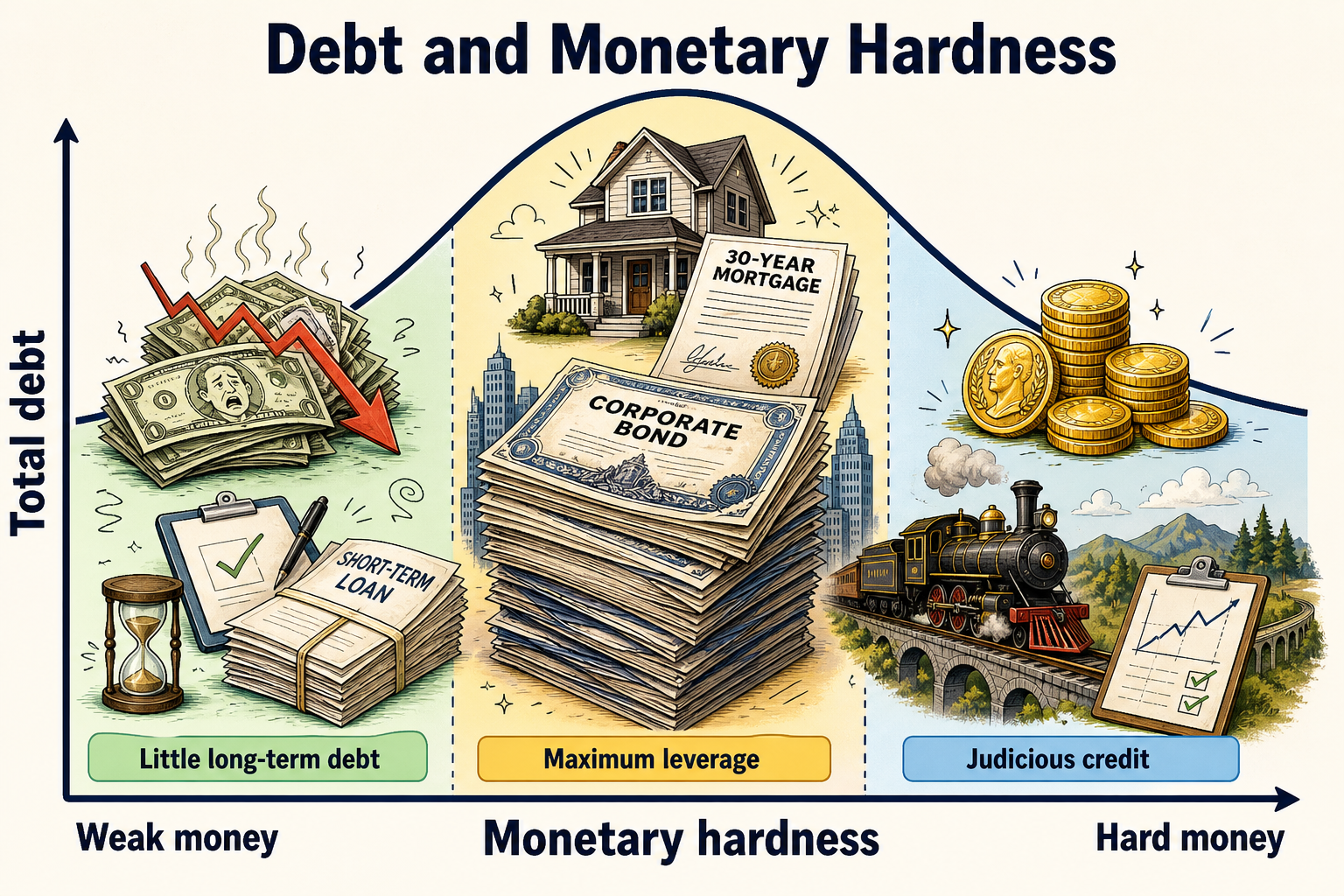
Elastic money can stabilize short-term crises. Structural problem: incentives and politics bias toward more claims over time, with resets via inflation, default, or restructuring. Gold stock grows ~1–2%/year; broad fiat in many countries grew mid-single to double digits for decades (book’s cross-country sketch). Savers in the unit are the residual claimants of dilution.
QE vs fiscal channels
❓ Why did 2020–22 inflation surprise people who watched only 2008 QE?
Alden’s Mary/Sara balance-sheet examples (from her 2020 banking/QE writing, embedded in Ch 15) stress who ends up holding deposits and whether fiscal transfers put purchasing power into goods markets. 2008-era QE largely recapitalized bank reserves; 2020 paired base expansion with large fiscal flows to households and firms. Consumer price inflation then hit multi-decade highs in 2021–22—consistent with her transmission emphasis, not proof of a single-factor model.
2023–2026 banking/money updates
❓ Did the system heal after 2023 bank stress?
SVB and peers showed duration risk and social-media run speed on mark-to-market losses—fragility inside a rate-hike cycle after a decade of low rates (book intro cites related 2023 fragility research). Fed balance sheet: peak ~$8.9T post-COVID; QT reduced it toward ~$6.5T by late 2025 before QT end and a return to slow balance-sheet growth to keep reserves “ample” (CRS IF12147, Dec 2025). M2 dynamics decoupled somewhat from the balance sheet during QT (market commentary 2024–25)—reminder that base and broad are not the same dial.
MMT tension
❓ Does “we owe it to ourselves” refute debt entropy?
MMT correctly notes sovereigns in their own floating currency differ from households. Alden’s counter is political-economy and inflation risk: capacity constraints, distribution, and loss of hard external anchor still bite—especially outside the deepest reserve currencies. Critique is integrated, not dismissed.