A long-form essay
The Shared Computer
Grok Bot, Hermes Agent Bots, and the agentic stack layer that became the plot.
Last updated: 2026-08-25
On 11 August 2026, an account that had existed for four days posted a video. The handle was @bot. The sentence was short: Bots are AI teammates that do real work for you. They sign in to your tools, use them just like you do, and come back with finished work.
Robert Scoble watched his feed fill with praise and wrote that there is nothing like having a great team working for you. Lenny Rachitsky, who had been in the early beta, said he had not been this excited about a new AI product in a while. It was like OpenClaw, he wrote — the open, slightly terrifying class of self-hosted agents — except easy, reliable, and less scary. He was already matching job-seekers to companies, auto-replying to support mail, scanning credit-card statements for subscriptions to kill, and getting podcast briefs he actually wanted to read.
Ben Lang, who builds at SpaceXAI via the Cursor team, called it the AI product of 2026. A reply called that an awkward self-pat. Both things can be true. The product is a teammate SKU. The company selling it is also the company that built the glass you sign into.
Two days later, on 13 August, Teknium — cofounder and lead engineer of Hermes Agent at Nous Research — posted a plugin. For one day, anyone running Hermes Desktop could clone a folder, reload plugins, and get a left-hand roster of named bots: avatars, forever-chats, @mentions, routines, group rooms. Three thousand people liked the announcement. On the 16th the same idea landed in the monorepo as a default-on plugin. By the 19th the release notes were tightening group-room threads and avatars. On the 21st, SpaceXAI widened Grok Bot to more SuperGrok and Cursor plans.
The internet treated this as a copy war. It was, in part. They copied clothes.
They did not copy the body.
A bot, in ordinary speech, is a named thing you message that then does work. That sentence hides four machines.
Cognition is a large language model proposing the next step. A large language model is software that predicts useful next tokens, and, when wrapped well, useful next actions.
The constitutive agent is a model plus standing instructions plus tools. That is the thing this house already names with the ugly, honest pattern *_agent_*. It is not a person. It is a configuration that can propose work.
The harness is the loop. It keeps calling the model, dispatching tools, compressing context, and stopping. Conversation is not agency. The loop is.
The host is the computer where those tools actually run. A file write, a browser click, a git push, a refund in a SaaS admin panel — none of that happens “in the model.” It happens on a machine with a disk, a network, and, if you are not careful, your cookies.
Grok Bot and Hermes Agent Bots both sell the first sentence. They assemble the four machines differently.
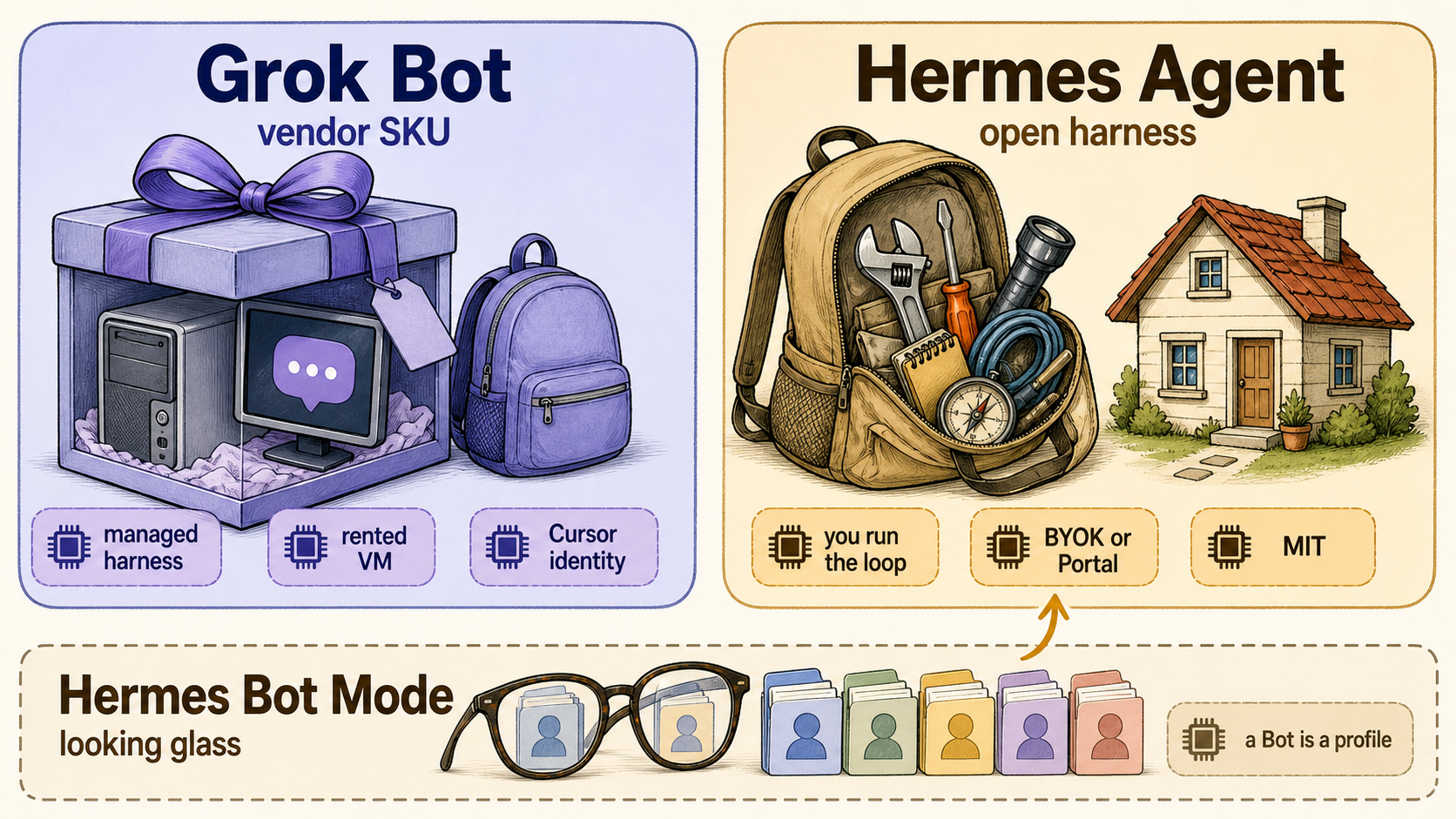
Grok Bot is a vendor-provided agent: a commercial SKU that ships a pre-assembled teammate under the vendor’s control plane. Model access, tools, managed loop, identity, UI. You rent the stack. If you cancel, the product stops.
Hermes Agent is an open process harness: MIT-licensed software you run whose job is the loop. You bring, or rent, a model and a host. Hermes Bot Mode is not a third product class. It is a looking glass over profiles you already had.
A looking glass is the surface where a human sets a goal, watches steps, hits a gate, and takes the output. Chat is one glass. Telegram is another. A desktop roster of named teammates is a third. The glass is not the stack.
That distinction is the whole article. Everything else is what it costs to get it wrong.
In November 1961, at MIT, Fernando Corbató’s group demonstrated a prototype of what became the Compatible Time-Sharing System. Three people typed at IBM Flexowriters attached to one IBM 709. The old ritual had been a deck of punched cards handed to an operator, then an hour of waiting for printout. Time-sharing did not give each person a computer. It gave each person a console on a computer they did not own.
That is Grok Bot’s product, restated for 2026.
Each member — one human account — gets one dedicated managed Linux virtual machine. All of that member’s Bots share it. Files, browser cookies, signed-in sessions, and command-line credentials are account-scoped, not Bot-scoped. Each Bot gets its own screen, so they can click in parallel. Screens are not security boundaries. Durable project files live at /workspace. Temporary directories and manually installed packages are replaceable. Closing the laptop does not stop the cloud work. You can watch via Agent Computer, take over for a password or a 2FA prompt or a CAPTCHA or a payment, then hand the mouse back.
The official security page is unusually honest. Do not use separate Bots as a security boundary. Deleting a Bot does not wipe the VM’s files or sessions.
Grok optimized coordination latency. The sales Bot and the ops Bot already have the cookies. Handoffs are cheap because the office PC is shared.
Hermes optimized blast radius. A Bot is a Hermes profile: isolated config, memory, skills, credentials, and chat history under ~/.hermes/profiles/<name>/. Bot-to-bot mail is a CLI handoff, not a shared cookie jar. Group rooms can even span machines. Turning Bot Mode off leaves the profiles, the sessions, and the cron jobs. The UI owns no data.
This is the same design fork as one shared corporate laptop versus one laptop per contractor. Both are rational. They fail differently.
If Grok isolated cookies per Bot, overnight CRM handoffs would need a secrets plane they currently get for free. If Hermes shared a browser profile across Bots by default, a compromised “researcher” Bot would read the “payroll” Bot’s sessions — the failure mode Grok documents in the open.
The scarce object is not a smarter model. It is a durable runtime host with identity and disk.
In 1770, in Vienna, Wolfgang von Kempelen showed Maria Theresa a wooden cabinet with a mannequin in a turban. The Turk played chess. Doors opened. Drawers opened. A candle was shone through the works. The machine won. For decades the argument was magnetism, a dwarf, a trained monkey, spirits. Edgar Allan Poe, watching it in Richmond, insisted a human was inside. He was right about the human and wrong about the mechanism. The cogs were decoys. A sliding seat on greased rails hid an operator who watched magnets under the board and moved the Turk’s arm with a pantograph.
The useful lesson is not “AI is a hoax.” The useful lesson is older and ruder: do not confuse the cabinet with the player.
Grok Bot’s cabinet is the persistent VM. The player is a managed harness calling a model you cannot pick, clicking through apps that never shipped an API. Hermes’ cabinet, if you have not bought one, is your laptop — or a Docker container, or an SSH box, or a serverless sandbox that hibernates, or a preview Cloud container that scales to zero. The player is a loop you can install, inspect, and keep after the bill lapses.
People who say “each Grok Bot gets its own computer” have opened the wrong door. Official docs say the opposite. The screens look private. The cookie jar is not.
Walk the stack from the bottom, because that is how the failure actually happens.
Model. Grok Bot has no in-product model picker. SpaceXAI routes a fixed set. Failover is their problem and their opacity. Hermes will let you /model mid-session. Different Bots can pin different labs. A Nous Portal subscription is the easy way to pay for three hundred models on one bill. It is not a requirement. Cancel Portal and the harness still runs with keys you brought or a model on disk.
Persistent state. Databases, ledgers, HR systems, the general ledger — those already existed. Neither product is a system of record. Grok’s /workspace is a project disk on a rented VM. Hermes’ ~/.hermes/ is config, memory, and skills on a host you operate. Grey stays grey. If you let either of them become the books, you have not adopted agents. You have lost the books.
Tools. The model can only propose a structured act. The tools layer is who runs it, and the host is where the side effect lands.
Grok offers three paths, in the order the docs recommend. First, connectors — Plugins — structured APIs, account-wide, not per Bot. Second, MCP servers, with team policy inherited from Cursor: allowlist, denylist, disable-all. MCP is the Model Context Protocol, a standard way for a client to expose tools from an external server. Third, computer use: click the actual website when the first two do not exist. That last path is the launch differentiator. Legacy SaaS never shipped a clean API. Grok’s answer is a mouse on a cloud desktop.
Hermes offers sixty-plus built-ins on a local loop — filesystem, patch, search, shell, browser, vision, memory, skills, cron, Kanban — plus MCP, plus whatever CLI you already trust. A house rule still holds: scriptable CLIs beat MCP for one-off local ops; MCP wins for reuse across clients. Hermes speaks both. Portal’s Tool Gateway rents the painful ones — Firecrawl, FAL images, OpenAI speech, a cloud Chromium, optional Modal sandbox — so you do not mint five API keys. Rented tools are not a rented office.
Computer use is not the host. Computer use is a tool family: pixels, accessibility tree, mouse. The host is where that tool runs. Grok combines them on purpose. Hermes can click via Browser Use or a local browser on whatever backend you set. An agent on local is powerful and stops when the laptop sleeps.
Skills. Same word, two depths. A Grok skill is reusable how-to: when to use, inputs, sequence, validation, output, approval rules. You can save one after a good run. You can teach a task by recording up to ten minutes of visible computer interaction, no microphone; the product drafts a skill you must then add decision rules to. A Grok routine is a schedule or an event. Test runs do real work. Max fifty routines per Bot.
A Hermes skill is a SKILL.md file, optionally with scripts and references, progressively disclosed — name and description always, body on trigger — installable from a hub, writable by the agent, curatable, pinnable. You can git it. You can publish it. A Hermes routine is a cron job. Bot Mode namespaces it so the Desktop roster and the CLI are the same truth.
Grok borrowed the word and shipped teach-by-showing first as a product. Hermes still owns procedural memory as a versioned artifact.
Harness. Both products pass the inclusion test. There is a loop, a tool interface, context management, and control. Grok’s harness is managed and not inspectable. Compaction and tracing stay inside the vendor. Team audit of Bot actions is, as of late August, still “coming.” Hermes’ harness is the thing you install. Sessions export. /compact is a command, not a rumor.
Multi-agent. Bonus level, not a requirement. You can have a useful agentic system with one native desktop harness and no orchestra. Grok’s launch even brags that you skip workflow setup. Group chat of Bots, on either side, is collaboration UX. Crash-durable work still wants a board — Hermes Kanban, or an external ticket system — because a chat thread is a glass, not a queue that survives a crash.
Looking glass. Grok’s is Desktop on Mac and Windows, plus iOS, same thread, Cursor identity. There is no Linux glass. The computer is Linux; you watch it from somewhere else. Legacy Privacy Mode is a hard block. Hermes’ glasses are many: CLI, TUI, Desktop sessions, Desktop Bot Mode, a gateway into Telegram and Discord and Slack and twenty other places, plus a Cloud preview that is not tied to one device. If the critical path is single-homed on one glass, 2 a.m. fails in one place.
Human in the loop is not “a human is using the chat.” A gate is a product primitive: a class of action that cannot proceed, a durable paused state, a packet of context, a recorded decision, a resume or a cancel. Grok’s best gate is takeover of the VM for 2FA — a real primitive. Hermes’ best gate is that you own the log, plus a Kanban card that can sit on blocked. Both still lean on sentences in a Bot description — “never send without approval” — for too much of the blast radius. A sentence is not a gate.
Nous Portal is the question people ask when they already like Hermes and want Grok’s overnight computer without leaving.
It does not give them that.
Portal is one OAuth for models plus a Tool Gateway plus, in preview, Hermes Cloud: an always-on agent in a hardened container, billed to credits, scale-to-zero when idle. Memory lives with the agent. Telegram and Discord still work. What the pages do not document is a furnished Linux desktop with your Slack cookies, /workspace, and parallel Bot screens.
If Portal lapses, local Hermes plus bring-your-own keys still run. Gateway tools that were proxied stop. The Cloud agent stops. Skills, profiles, and git repos were never Nous’s to keep.
SuperGrok and Cursor inclusion is the mirror image. Grok Bot rides Cursor SSO. Invoices combine. Weekly usage allowances exist; a Bot-specific spend cap, as of the teams doc, does not. There is no model picker. Contracts that limit subprocessors have to talk to the account team before rollout. The product is Cursor-shaped: MCP policy, privacy modes, Cloud Agents toggle. That is not a smear. It is where the identity lives.
Operate versus rent is the right axis. On-prem versus cloud is the wrong one. You can operate a VPS in someone else’s building. You can rent a VM that happens to sit in a region you like. Grok’s computer is rented and operated by the vendor. You use it. You do not SSH in as a first-class admin. Hermes lets you operate local, Docker, SSH, or a handful of sandboxes — or rent Cloud preview. The closest Hermes equivalent of “work continues when the laptop closes,” today, is you placing the harness on a machine that does not sleep. Grok Bot is that machine, pre-furnished, with a live desktop view.
The week of 11 August was not the invention of named teammates.
Hermes already had profiles, a messaging gateway people already nicknamed “bots,” skills, cron, memory, and Kanban. The open-harness water — Claude-class loops, OpenClaw, scheduled tasks, MCP, AGENTS.md — had been circulating for a year. Grok did not invent skills or cron or MCP. It productized a persistent VM plus a coworker glass and shipped it to people who already paid for Cursor or SuperGrok.
Hermes did not invent named teammates on the 13th. Teknium put a Grok-like glass on primitives that already existed. What was new as product was the roster replacing the session-first mental model, a canonical forever-chat so /new becomes compact instead of a fork, a “needs you” badge, small group rooms with round caps, and a teammate protocol injected into every Bot Chat — including headless CLI — so handoffs do not require editing a soul file.
Looking-glass teammate UX copies in days. Persistent tenant-safe computers copy in quarters.
That is a stepwise product story, not an exponential one. Two weeks of SKU expansion is not a doubling time. The mechanism is software substitution plus competitive copying of surfaces. The bottleneck is isolation, audit, and whether a cloud VM will ever sit inside the identity systems enterprises already trust. Hardware security keys in Grok’s VM browser are forwarded to the member’s desktop. That sentence is a small monument to how hard “sign in like you” actually is.
A separate SpaceXAI product, Grok Build, is a coding agent: terminal UI, headless, the Agent Client Protocol. Fair peers for coding are Grok Build, Claude Code, Codex, Hermes CLI. Fair peers for teammate bots are Grok Bot, Hermes Bot Mode, OpenClaw-style rosters. Mixing them inflates Grok’s computer as if it were a repo loop.
The objections are real, and they belong in the middle, not a footnote.
OpenClaw, Claude Code, and Codex are the real peers if you only write software. Then Grok Build matters more than Grok Bot. Grok Bot’s buyer is not shopping a coding protocol. They want a named digital employee on a cloud PC.
The shared VM is a security foot-gun sold as a feature. Prompt injection on a logged-in Gmail tab is worse than on a hermetic sandbox. Regulated shops should treat shared-browser agents as forbidden until per-bot tenants exist. Grok says this, in different words, on its own security page.
Hermes with approvals off on local is worse than Grok’s VM. Defaults matter more than architecture slides. Docker or SSH plus approvals changes the comparison. YOLO on a personal laptop does not.
Multi-bot group chat without a board is theater. Three rounds and ten messages is a conversation, not a durable workflow.
“Always-on computer” could still be an ephemeral container with good copy. Grok documents recover, reset, and replaceable temp state. If /workspace and cookies routinely vanish, the claim fails. That is not public yet.
Unreviewed self-improving skills poison procedural memory on both sides. Hermes has a curator and a pin. Grok’s teach-a-task drafts can encode one lucky demo, including secrets if you were sloppy.
Neither product is a superintelligence. Both can send mail and move money if you approve the wrong card. The automation problem on the global list is not abstract here. It is a refunds-manager Bot with a logged-in session.
What should change in the drawing is smaller than a new religion and larger than a caption.
The house stack already distinguished harness from host. The public poster still folds “computer” into Tools as an execution environment, a safe sandbox, a shovel icon — and hangs a “where it runs” banner on Harness. Grok Bot makes that miss expensive. Promote the host. Draw local machine, container sandbox, SSH, persistent desktop VM, serverless hibernate. Keep the color language: operate versus rent, not on-prem versus cloud.
Draw identity as a cross-cut, not a band. Cursor SSO and Nous OAuth are why these are products, not scripts.
Mark shared versus isolated on the host. Do not invent a layer called Bots. Do not promote computer use into a band. Do not promote voice, or a marketplace, into a band. Those are glass, tool family, modality, distribution.
The next honest product, from either side, is per-bot tenants on a persistent host. That would close the last real gap. Until Grok ships isolation and a log you can take, or Hermes Cloud ships a real desktop with computer use and account-wide plugins, they are cousins exchanging clothes.
Compare packaging, then host, then glass. Model leaderboards are the least interesting part of this pair.
Choose Grok Bot if the job is stay logged into messy SaaS and finish the clickpath overnight, and Cursor gravity is acceptable.
Choose Hermes Bots if the job is own the loop, swap models, isolate specialists, and live in Telegram or a Linux box or a CLI you already have. Portal makes that path less painful. It does not make it the other product.
Do not treat Bot Mode and Grok Bot as the same thing. One is a UI over profiles. The other is a SKU over a VM.
Keep the general ledger grey.
On 11 August the cabinet arrived already furnished. On 13 August someone who already owned the tools hung a nicer set of eyeglasses on them. The feed called it a race. It was a reminder.
The teammate is a costume. The computer is the plot.
References
Research appendix (this site)
- Research appendix home
- Research index
- What they are
- Stack overlay
- Persistent computer
- Tools, skills, harness
- Looking glass and HITL
- Nous Portal
- Idea borrowing
- Stack gaps and outlook
- Question ledger
- External primary sources
Primary sources
- Introducing Grok Bot
- Hermes Agent documentation
- Nous Portal
Full dossier
Eight architecture chapters, sources, the release trail, podcast signal, illustrations, and the master question ledger.
Pick a real place. Use what this essay made possible. You lead.