Last updated: 2026-08-16
Mirror life is a living cell
In 2019, Kate Adamala’s lab had a grant aimed at a long-term goal that sounded like science: build a cell from the other hand of Earth’s chemistry. That goal is what people now call mirror life.
Mirror life would be a living organism whose DNA, RNA, and proteins are the opposite hand of ours. The first version anyone thinks is plausible is not a mirrored squirrel. It is a mirror bacterium — a cell that can feed, copy its parts, and divide.
A mirror peptide in a medicine bottle is not that. A short stretch of opposite-handed DNA in a test tube is not that. Those are parts. Parts do not eat, hide, or spread on their own. A cell does.
No such cell exists. The worry, and the strategy, are about whether anyone should ever finish one.
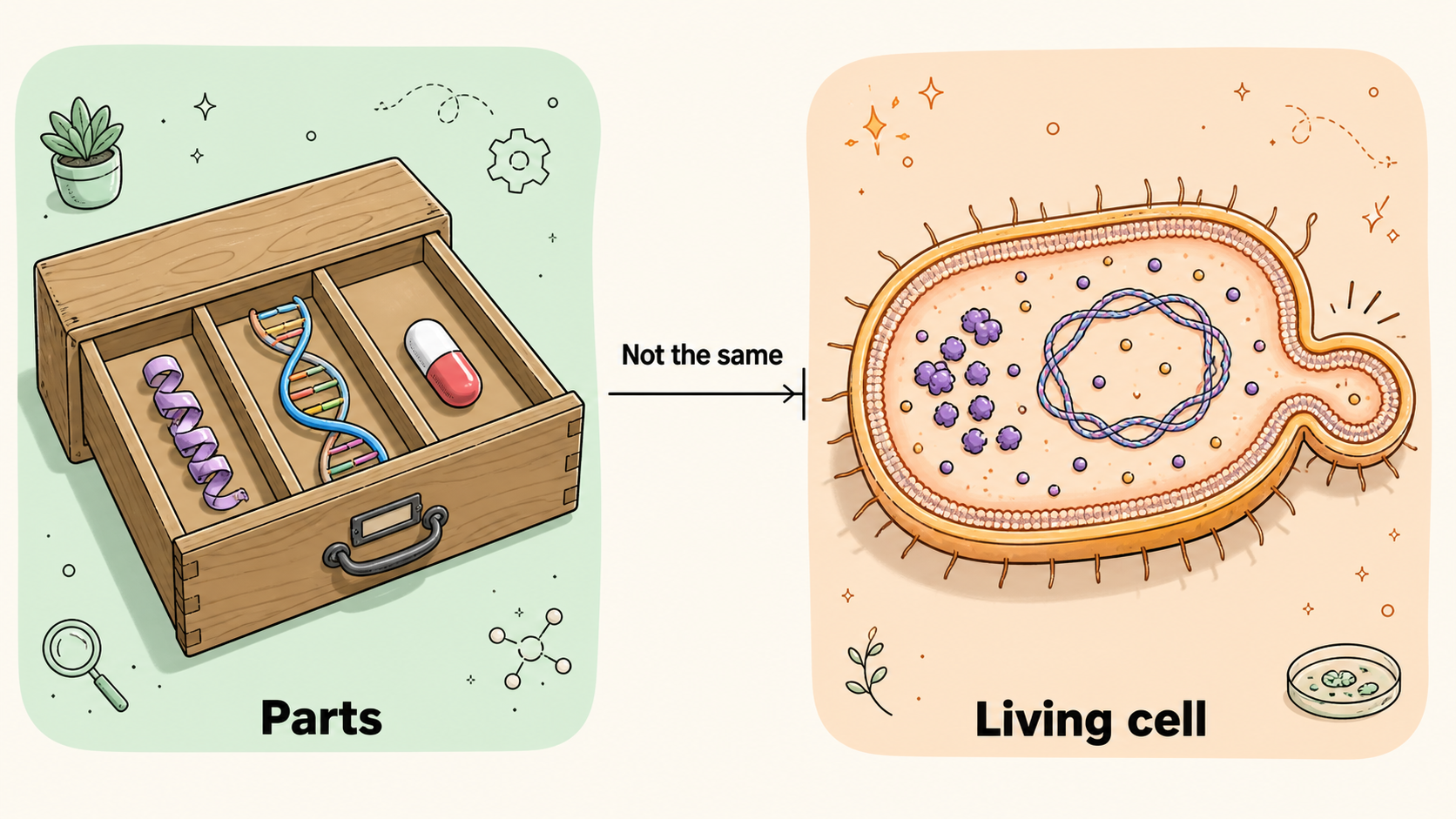
Naming the object stops two mix-ups at once: treating every chiral drug as a doomsday device, and treating a future bacterium as “just more chemistry.”
The tempting mistake is to use one phrase, “mirror life,” for both the pill and the organism. They are not the same kind of thing.
That is what lets you ask why a living opposite-handed cell would be hard for bodies and ecosystems to handle.