Last updated: 2026-08-15
Children the marriage did not have
❓ If the marriage is famous, why is it barren, and what does it produce instead?
It produces almost no joint children in the main line, and it produces at least one object that behaves like a curse with a genealogy. Aphrodite’s famous offspring are Ares’s. Hephaestus’s famous child is Earth’s. The marriage itself, when it is remembered as a marriage, is remembered for what it failed to contain.
Aphrodite’s children are mostly Ares’s
❓ Who are Harmonia, Eros, Phobos, and Deimos said to belong to?
Thebans said the union of Ares and Aphrodite produced Harmonia.[6] Lyric poets can make Eros the child of Aphrodite and Ares: Ibycus and Simonides both do.[25] Phobos and Deimos, Fear and Fright, attend Ares and are often listed as that pair’s sons.[6][25] Popular summaries are blunt: Aphrodite had no children with Hephaestus.[6]
That barrenness is not an accident of missing sources. It is the point of the pairing. Desire plus war produces Harmonia — a goddess whose name means the fitting-together of opposites — and then produces panic. Desire plus craft produces, in the main stories, nothing that needs a cradle.
Some later and local lists give Hephaestus other children: the Cabeiri on Lemnos by the nymph Cabeiro; Thalia by Aetna; Periphetes the club-bearing bandit; in Roman story, Servius Tullius by Ocresia.[2] Those are smith-children, island-children, fire-children. They are not Aphrodite’s.
The Necklace of Harmonia
❓ What object carries the marriage into the next generation?
A necklace. Harmonia, daughter of the affair, marries Cadmus, founder of Thebes, at a wedding the gods attend. The most common later version says Hephaestus, still angry, gives her a finely worked necklace and sometimes a peplos, a robe, and the gift brings misfortune to every woman who wears it, down through the Theban queens, Eriphyle, and the line that ends in the story of Oedipus.[6][9][10]
Apollodorus already knows a peplos and a necklace that Cadmus received “either from Hephaestus or from Europa.”[10] Pherecydes can say Hephaestus gave the necklace to Cadmus.[10] Statius, in the Roman Thebaid, will linger on “the dread necklace of Harmonia” and the Lemnian smith’s long labor.[10] The later the source, the more explicitly the object is revenge for the bed.
A wedding attended by gods. The lame husband of the bride’s mother steps forward with a piece of jewelry so beautiful it cannot be refused. Harmony puts it on. Thebes is now wearing a smith’s memory of a net.
The necklace is the marriage’s true child: portable, inheritable, and unable to stop doing what it was made to do.
Erichthonius, the child who is not Aphrodite’s
❓ What does Hephaestus father when the marriage plot is over?
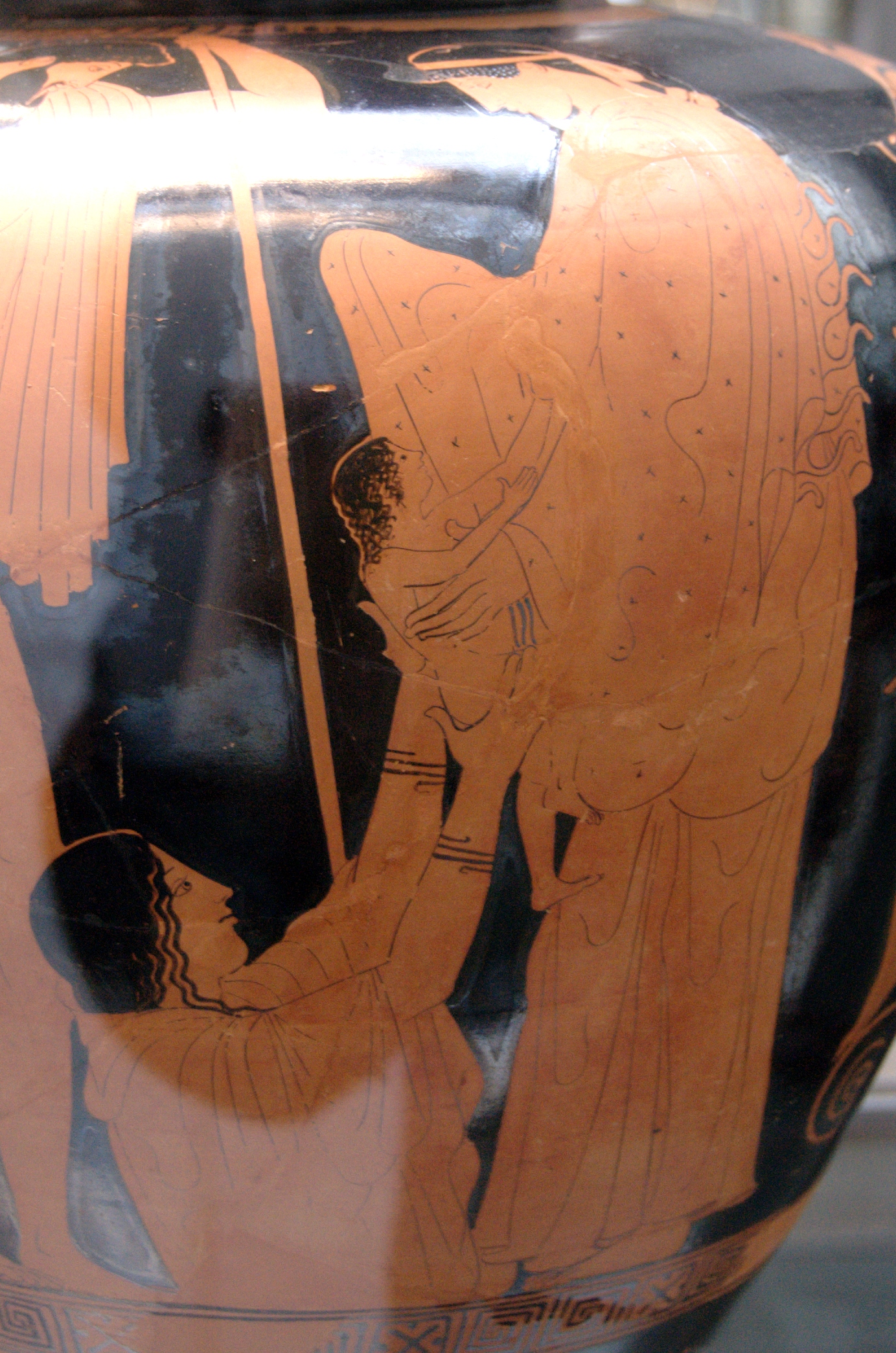
Athena. Or rather, he fails to. He tries to rape the virgin crafts-goddess. She fights him off. Semen falls on her thigh. She wipes it with wool and flings the wool to the earth. Gaia conceives. The child is Erichthonius, sometimes imagined as infant-plus-serpent. Athena puts him in a box, gives the box to the daughters of Cecrops, and tells them not to look. They look. Terror. An early king of Athens is born from a failed assault and an act of cleaning.[2][13]
This story is Athenian, not Cypriot. It explains why the city can claim a child of Earth and the smith, raised by the goddess of the Acropolis. It also shows Hephaestus’s desire without Aphrodite: not comedy, not a net, not laughter. A craftsman reaching for the other crafts-goddess and producing a civic ancestor by accident.
The contrast is the finding. With Aphrodite, his jealousy becomes an art-object and a public joke. With Athena, his desire becomes a founding myth and a snake in a box.
Pandora, the other made woman
❓ Is Pandora part of the Aphrodite file?
She is part of the Hephaestus file that explains why the Aphrodite file matters. Zeus tells Hephaestus to plaster earth with water, give it voice and strength, and make a face like the immortal goddesses. Athena dresses her. The other gods add gifts. Hermes names her Pandora, because every Olympian gave her something, “to be a sorrow to men who eat bread.”[1]
Hephaestus can make a woman. He cannot keep the woman he was given. That is the cruel rhyme between Pandora and Aphrodite. One is clay dressed as a goddess. One is a goddess treated as transferable goods. Both are assembled by male will. Both then do work no assembler can recall.