Research · Naive 100× vs Try 1×
Productivity math
Last updated: 2026-08-12
The productivity math (naive vs human oversight)
❓ If AI is “100× faster,” why does the honest number look more like 1.1–1.4×—and why is that still a big deal?
This section is the economic core. All averages below are from Patwardhan et al. appendix A.2 on the 220-task gold set, unless noted. Arithmetic was independently recomputed from the published formulas and Table 2; it matches.
The ingredients
| Symbol | Meaning | Gold-set average (paper) |
|---|---|---|
| HT | Human expert time to do the task | 404 minutes (~6.73 h) |
| HC | Human labor cost proxy (hours × BLS median wage) | $361 |
| RT | Human expert time to review a model deliverable | 109 minutes (~1.82 h) |
| RC | Review labor cost proxy | $86 |
| MT | Model completion (inference) time | Inferred from naive ratios (GPT-5 ≈ 4.5 min) |
| MC | Model API cost | Inferred (GPT-5 ≈ $0.76 / task in their sample) |
| w | Model win rate vs human (better than human) | GPT-5 39.0%; GPT-4o 12.5%; … |
Wages are BLS medians, while experts are seniors—so dollar savings are conservative underestimates of true senior-loaded cost. Time figures are validated self-reports, not stopwatch industrial engineering.
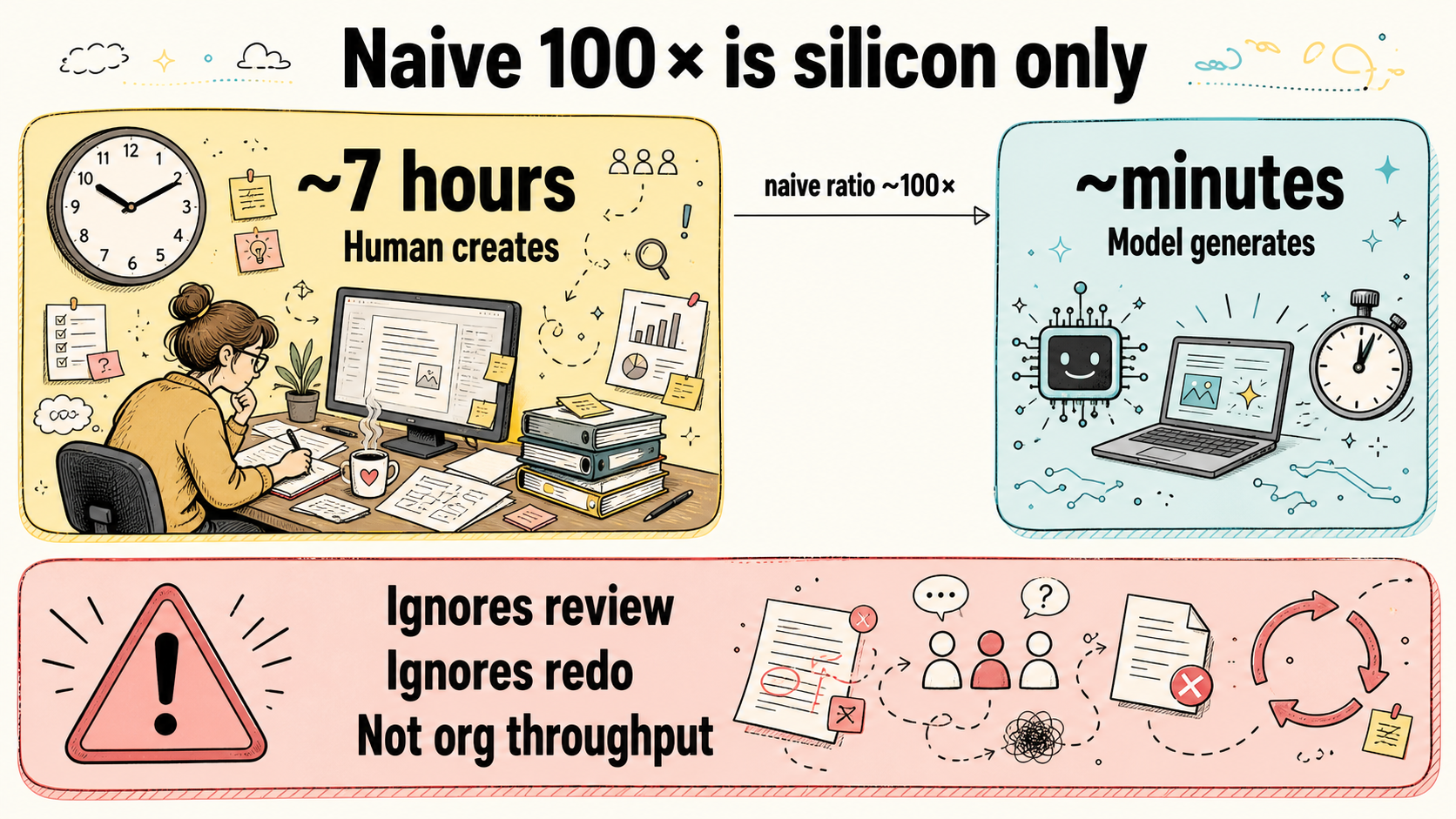
Scenario A — Naive “robot alone” ratio (the viral 100×)
For GPT-5 the paper reports about 90× faster and 474× cheaper on pure inference vs human completion cost. Across frontier models, OpenAI’s blog rounds the spirit of this to “roughly 100× faster and 100× cheaper.”
What this measures: silicon time and API invoice vs a human sitting down cold.
What it ignores: reading the output, fixing it, integrating it, liability, rework, and the cases where the model is worse than the human.
Naive 100× is a capability physics statement (“generation is cheap”), not an operating model statement (“your department ships 100× more”).
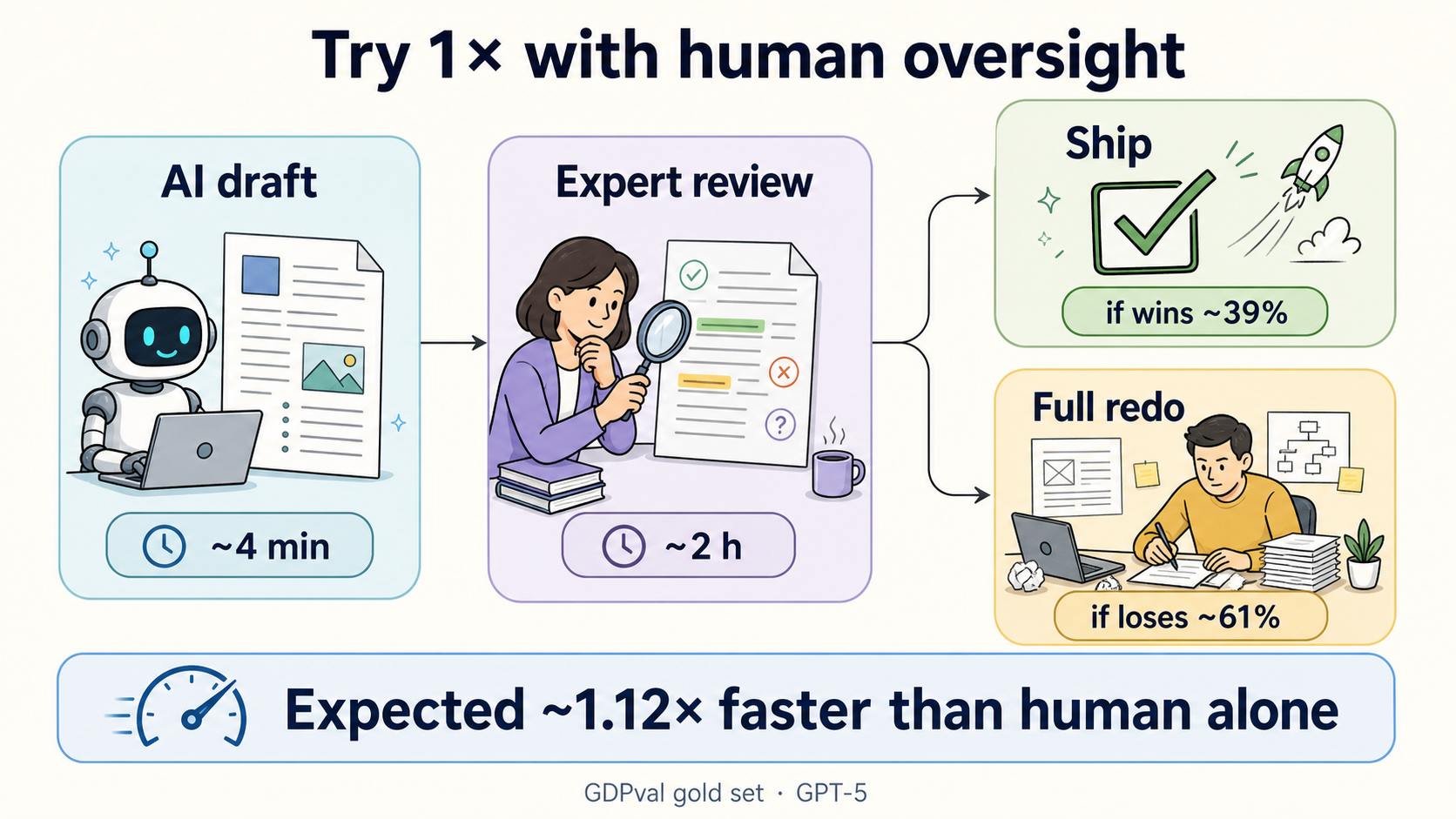
Scenario B — Try once, review, else do it yourself (Try 1×)
This is the first honest workplace proxy in the paper:
- Ask the model.
- Pay an expert to review (RT).
- If the model did not win (probability 1 − w), the human does the full task.
Expected time and cost:
Speed / cost improvement vs unaided human:
Reproduce GPT-5 (Table 2)
Using w = 0.39, HT = 404, RT = 109, MT = 404/90:
Cost side likewise → about 1.18× cheaper (C1 ≈ $307 vs $361).
| Model | Win rate w | Naive speed | Try 1× speed | Try n× speed | Naive cost | Try 1× cost | Try n× cost |
|---|---|---|---|---|---|---|---|
| gpt-4o | 12.5% | 327× | 0.87× | 0.46× | 5172× | 0.90× | 0.53× |
| o4-mini | 29.1% | 186× | 1.02× | 1.06× | 1265× | 1.06× | 1.22× |
| o3 | 35.2% | 161× | 1.08× | 1.28× | 480× | 1.13× | 1.47× |
| gpt-5 | 39.0% | 90× | 1.12× | 1.39× | 474× | 1.18× | 1.63× |
Read the table left to right: the miracle shrinks when you pay for judgment—and for weak models it goes negative.
Scenario C — Try many times, then fix (Try n× → ∞)
If the expert may resample the model up to many times before giving up, expected time converges (for w > 0) to:
so speed → HT·w / (MT+RT).
For GPT-5 that limit is about 1.39× faster and 1.63× cheaper—the paper’s Try n× column. Authors note this still over-penalizes models because real users raise w with better prompts and cut RT as they learn the task.
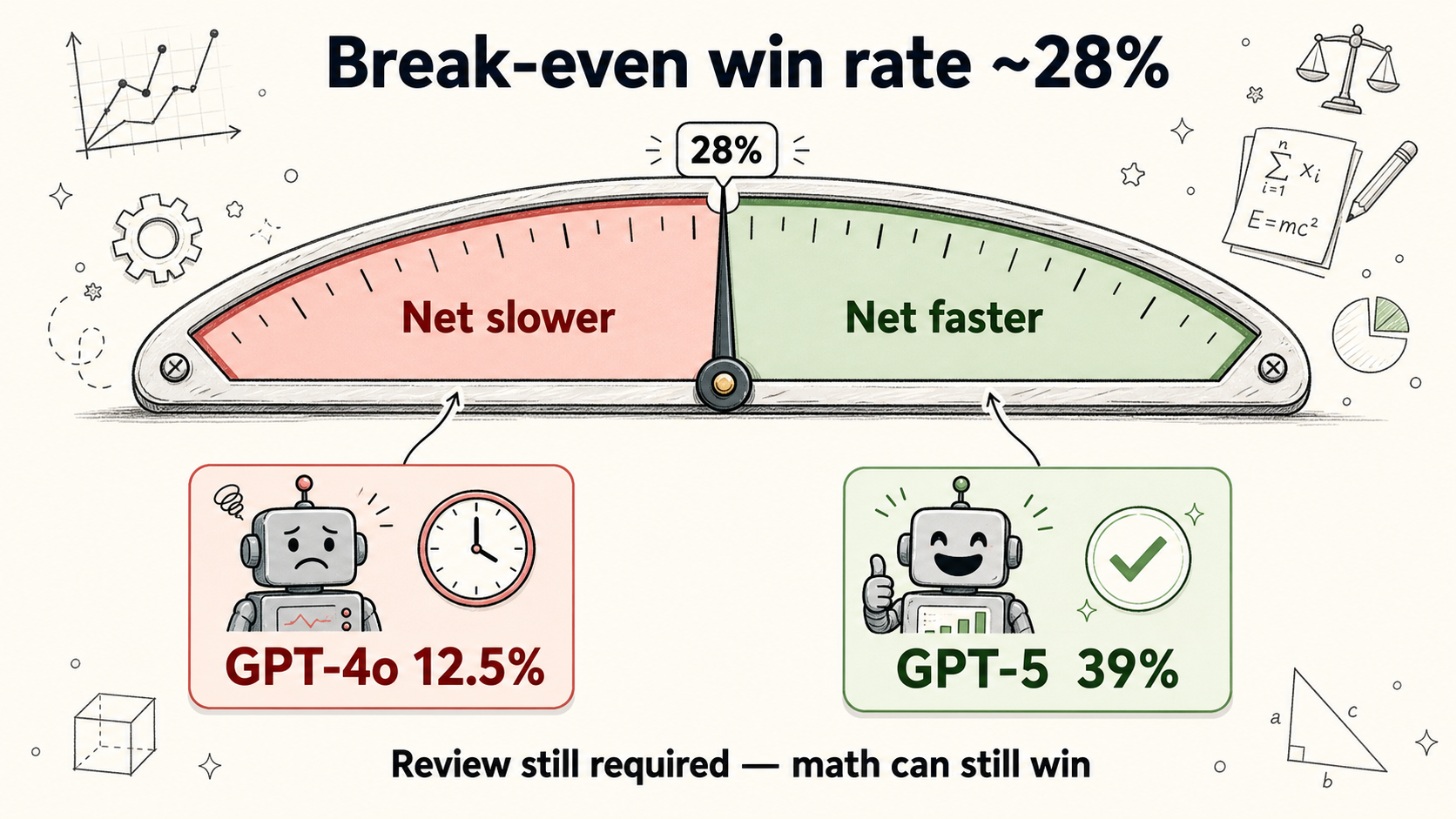
Break-even: when does review-still-required AI beat pure human?
Under Try 1×, AI helps on time when:
With gold-set averages and GPT-5-like MT:
Interpretation: once a model beats human deliverables more than ~28% of the time on your task mix (under this review cost structure), even a clumsy “draft then maybe redo” process is faster in expectation than always starting from a blank page. GPT-4o at 12.5% fails that test (0.87×). GPT-5 at 39% clears it. That single threshold is why the quality curve and the budget curve are the same story.
One average task in plain numbers (GPT-5, Try 1×)
| Path | Time | Labor+API cost proxy |
|---|---|---|
| Expert alone | 6.7 h | $361 |
| AI draft + expert review + probabilistic full redo | 6.0 h expected | ~$307 expected |
| Saved | ~44 minutes (11%) | ~$54 (15%) |
Eleven percent does not sound like science fiction. It is still enormous at portfolio scale—and it is the pessimistic end of the paper’s framing because:
- RT = 109 minutes is first-time external grading, not a warmed-up internal reviewer.
- Redo is modeled as full human restart, not “edit the AI draft for 20 minutes.”
- w is frozen across retries.
- Human-alone path is charged zero self-review/supervisor review, which real orgs often pay anyway.
Sensitivity: review time is the lever you control
Hold GPT-5 w = 39%, vary only review time:
| Review time RT | Try 1× speed | Minutes saved / task |
|---|---|---|
| 109 min (paper graders) | 1.12× | ~44 |
| 60 min | 1.30× | ~93 |
| 30 min | 1.44× | ~123 |
| 15 min | 1.52× | ~138 |
Manager translation: every process that turns “re-do the whole grade from scratch” into “structured checklist review in 15–30 minutes” multiplies the value of the same model. Model vendors sell w and MT; you own RT and task routing.
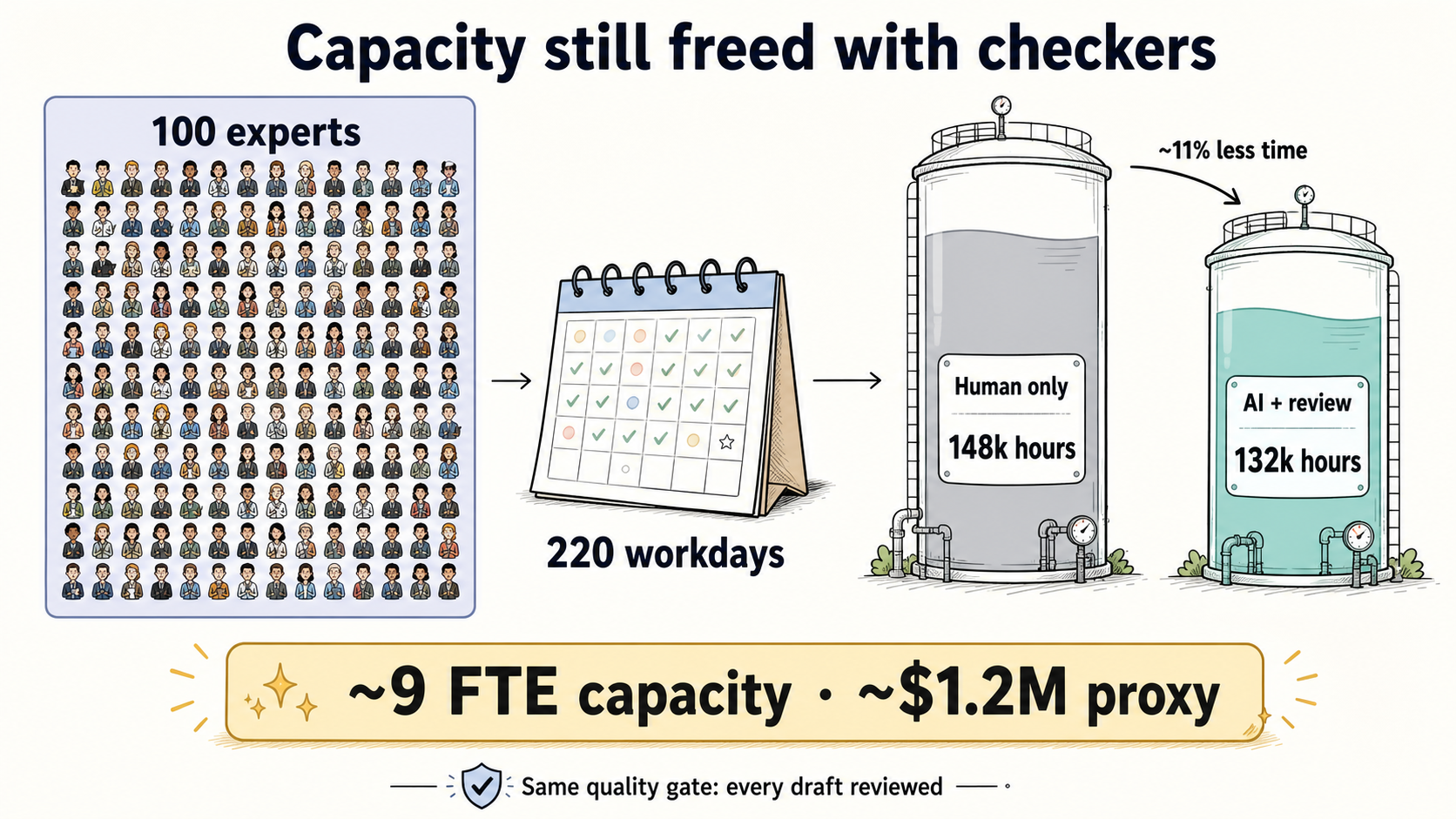
Scale picture: 100 experts, one gold-average task per working day
Assumptions: 100 professionals, 220 working days, one 404-minute-class task each day, GPT-5 Try 1× economics.
| Human only | AI + review + redo | |
|---|---|---|
| Hours / year | ~148,000 | ~132,000 |
| Hours freed | — | ~16,000 (~11%) |
| FTE-equivalent freed (@1,760 h) | — | ~9 people |
| Labor-cost proxy | ~$7.9M | ~$6.8M |
| Proxy dollars freed | — | ~$1.2M / year |
That is not headcount you must fire. It is capacity you can redeploy to judgment-heavy work, client ambiguity, exception handling, and volume you previously could not accept. If your real RT is 30 minutes and you only send high-fit task families (higher w), the freed band widens quickly toward the paper’s 1.4× time / 1.6× cost zone—or beyond if edits replace full redos.
Concrete scene: A senior associate used to bill a full day on a recurring package. Now the model drafts in four minutes. She spends half an hour on a red-team checklist. Four times out of ten she ships with light edits; six times out of ten she rebuilds. On average she still gets the afternoon back often enough that the practice takes more matters without hiring. That is GDPval economics in a hallway, not a press release.
Why “we still need humans to review” is not a refutation
The skeptical sentence is: If people must check the AI, why bother?
The math answers:
- Review is cheaper than creation on these tasks (109 min vs 404 min even in the harsh paper setup).
- Creation is skipped whenever the model wins (probability w).
- API cost is rounding error next to expert wages ($0.76 vs $361).
- Below ~28% win rate, the skeptic is right for Try 1×. Above it, the skeptic is leaving money on the table.
- The honest win is not 100× headcount deletion; it is double-digit capacity and cost improvement with quality gates still on—exactly what regulated industries can actually deploy.
What the math still misses (do not hide)
- Catastrophic errors with nonlinear cost (bad medical plan, bad legal advice).
- Integration, compliance logging, security review beyond content quality.
- Multi-turn client clarification time (may add work models currently skip).
- Benefits when humans also need review (two-sided QA).
- Gains when the human edits instead of fully redoing (paper understates upside).
For decision use: treat Table 2 as a lower-bound constructive proof that oversight-compatible AI can already beat unaided experts on average gold tasks for strong models—not as a universal ROI calculator for every workflow.