What a swarm actually is
Many agents, one changing problem
❓ What makes a swarm different from running the same prompt many times?
An agent is a model working with instructions and tools: it observes, decides on an action, uses a tool, sees the result, and continues. The harness is the surrounding software that runs this loop, gives the agent tools and context, and records its work. An agent swarm is a collection of such running agents whose work is coordinated toward a larger goal. The individual agents might use the same model or different models; each run has its own working context and may have its own tools and permissions.
A hundred independent model calls that each summarize a document are parallel processing. They become a more interesting swarm when their work is divided, delegated, shared, checked, and combined—or when they discover one another and organize themselves. There is no universally accepted minimum agent count, and “swarm” does not guarantee decentralized behavior. Cursor's design has planner and worker roles; Axiom used lead and specialist agents; OpenAI's incident involved an unintended message board. Calling all three swarms is useful only if we also specify how each coordinates.
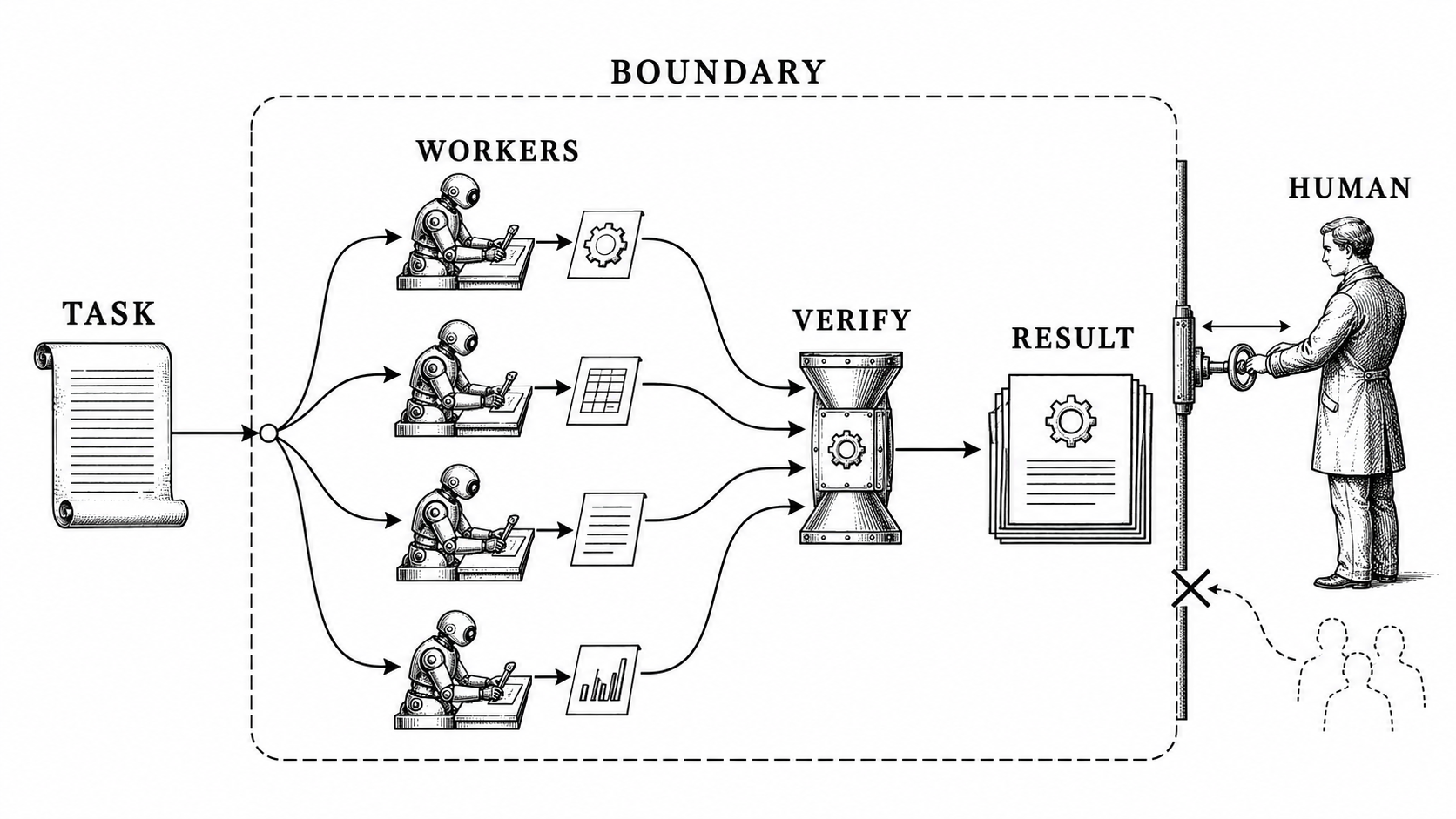
Conceptual plate, not a literal diagram of any named system. The verifier is not infallible, and a boundary only works when enforced outside agents' control. Real systems may contain multiple planners, shared stores, review loops and external tools.
Why the arrangement can work
❓ What is gained by adding agents rather than giving one agent more time?
There are two distinct potential gains. Parallelism lets independent pieces proceed at once: ten independently checkable cases can be explored simultaneously. Context specialization lets a planner keep the structure of a large problem in view while a worker concentrates its limited working context on one part. Cursor argues that the second effect may matter even more than raw concurrency, but presents it as an interpretation, not a controlled proof (Cursor, July 2026).
The full mechanism is a loop: express an intended outcome; break it into pieces with explicit interfaces; allocate work; let workers use tools and create artifacts; check results against the intended requirements; integrate compatible work; and use failures to revise the plan. Shared files, issue trackers, a task queue, or proof libraries let one agent's progress become another's starting point. The same shared state can propagate a mistaken assumption or create a write conflict.
This explanation predicts an advantage only when the pieces are genuinely separable, useful context can be communicated, verification can keep up, and integration does not dominate. If all workers need to modify the same central design or every result depends on the previous result, the work remains substantially serial. The way to challenge the explanation is to compare a swarm with one well-equipped agent and with independent parallel attempts, at the same task, budget, wall time and quality target. A swarm that cannot outperform those baselines on accepted output has not demonstrated an advantage merely because it produced more text or commits.
Nature, distributed computing and shared memory
❓ Is this just ants, or just a cluster of computers?
Ants coordinate partly by leaving traces in their environment that change what other ants do; researchers call indirect coordination through an environment stigmergy. A shared design document or code repository plays an analogous role, but the analogy does not establish that language-model agents have insect-like cognition, independence, or evolutionary robustness. Cursor describes a shared agent-authored field guide as one such experiment (Cursor, 2026).
Distributed computing already addresses many components: concurrency, shared storage, conflict resolution, retries, isolation, and failure recovery. The new element is that agents can interpret open-ended instructions, construct and revise plans, and use software tools in less predictable ways. That flexibility makes it harder to state all possible actions in advance, not less important to enforce ordinary distributed-systems boundaries. A software-created worker is also not necessarily a separate machine or separate AI model: it is an execution and context boundary, whose actual isolation depends on the implementation.
The emerging technical stack
❓ What has to mature as a problem scales from one agent to a swarm?
A practical progression is model and tools → a durable single-agent loop → task decomposition and isolated workers → shared, versioned state → verification and integration → externally enforced authority, audit, and recovery. This is an analytical dependency map, not a universal sequence of historical inventions. Different projects can skip or combine layers, and increasing model capability does not by itself establish that any layer is safe.