Last updated: 2026-09-15
2027 — Money rails and agentic commerce (predictions only)
❓ If GENIUS really turns on in January 2027, what changes in the dollar-on-a-chain, and what does not?
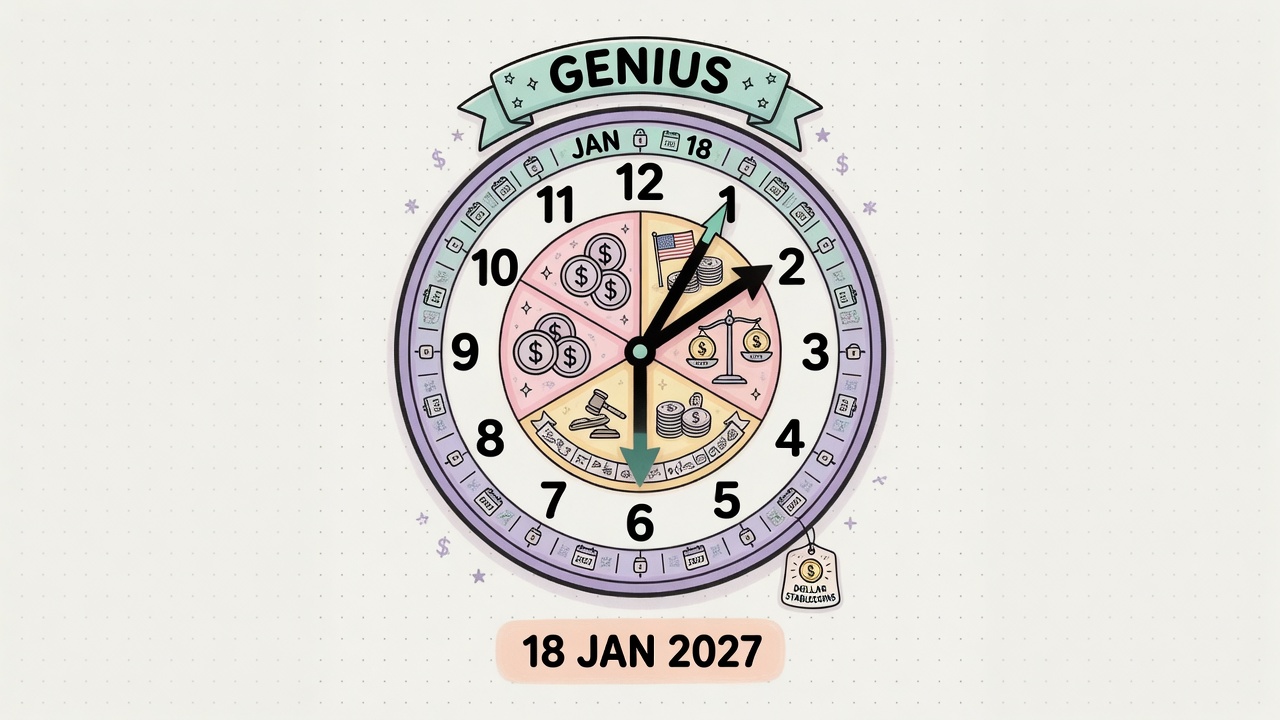
Again: nothing here has happened. Clocks that already started are labeled as clocks.
GENIUS effectiveness as the actual 2027 money event
❓ Is 2027 a stablecoin “floodgate,” or a rules-and-plumbing year?
Clock (HAPPENED): GENIUS signed 18 July 2025; 18-month implementation; widely cited full effectiveness 18 January 2027.
PREDICTION (holders: Treasury speech, bank-chain alliances, X commentary in Sep 2026): 2027 is when bank-issued payment stablecoins and tokenized deposits can sit inside a complete US federal framework; foreign issuers that comply can stay onshore-accessible; reserve demand for T-bills is a structural bid for US debt.
Counter-prediction (also held, and more consistent with 2026 prints): Supply has already plateaued near $300B. Intermediated share is rising inside crypto, not as a new retail rail. Cross-border payment share is still a rounding error. Rules without Fed master accounts, deposit insurance, and bank core integration do not automatically create a second checking system.
Falsifier: By 31 December 2027, either (a) GENIUS-compliant payment stablecoin supply is still ~25% of a still-flat ~$300B market, with no material bank-issued float, or (b) compliant supply has clearly broken out of the 2026 band (for example a sustained print above $500B on DefiLlama and stables.cool, not one dashboard).
CLARITY Act (US market structure) remaining in the Senate as of mid-September 2026 is a HAPPENED legislative stall. Treating 2027 tokenized-security scale as certain without CLARITY is an extra assumption.
Tokenized deposits versus public stablecoins
❓ Will 2027 be the year banks win the cash leg?
PREDICTION: J.P. Morgan, Citi, and bank consortia push tokenized deposits and tokenized government MMFs (JLTXX-class) as the institutional cash leg, especially where GENIUS reserve rules and bank supervision matter. Public USDC/USDT remain the crypto-native and cross-venue leg.
HAPPENED seed: OSFI (10 Sep 2026) already said tokenized deposits are not a new legal species in Canada. That pulls Canadian 2027 work toward deposit operations + B-13/B-10, not a new coin statute.
Falsifier: 2027, tokenized-deposit volume still boutique while public stables remain the only 24/7 dollar the machines can hold.
RWA 2030 figures ($2–5.5T tokenized securities in consultant ranges; higher in some long-term decks) stay in the PREDICTION column. 2026 on-chain RWA is tens of billions, concentrated in T-bills.
Agentic commerce in 2027: negotiate, or just checkout?
❓ What would have to be true for an agent to spend at scale without a human tapping “buy”?
Mastercard’s Short History of the Future of Shopping and Payments (as reported 15 Sep 2026): by 2027, agents could negotiate price at scale in some categories; by 2030, “top of wallet” weakens because an agent picks the rail (rate, cashback, fee, liability) per transaction. That is PREDICTION from a network.
What 2027 can inherit from 2026 without magic:
- Card-network agent tokens and passkeys already live in controlled rollouts.
- ACP/UCP checkout already live for some merchants.
- KYA work announced 10 Sep 2026 might produce an interoperable identity sketch — or three more silos.
What 2027 still needs and does not have as of this writing:
- Dispute and chargeback when the buyer is a loop.
- A single Know-Your-Agent that Visa, Mastercard, and Ant actually share in production.
- Stablecoin 402-style micropayments with consumer protection that a bank would recognize.
Falsifier: End-2027, still no published network-wide statistics of agent-initiated card volume as a material share of e-commerce (the $4,000 experiment remaining the honest “production” anecdote would be a miss for the 2027 negotiation story).
Juniper’s $1.5T by 2030 is not a 2027 claim. Do not sneak it forward.
Where AI agents and programmable dollars actually meet
❓ Why does this secondary topic belong in an AI-primary outlook?
Because computer-use agents create a machine-speed demand for settlement that human checkout does not. The agent that can fill a form can also hit an HTTP 402, a Shared Payment Token, or a USDC transfer. The scarce trust object then is not the model’s IQ. It is who the agent is allowed to be, for how much, at which merchant, with whose liability.
That is why KYA, TAP, Agent Pay, and x402 showed up in the same year as Astra. It is also why a $300B stablecoin float can be “huge” next to crypto and “tiny” next to Visa.
2027 PREDICTION worth tracking (narrow, falsifiable): at least one of (a) GENIUS-compliant bank stablecoin in production retail or treasury use, (b) a published Visa/Mastercard agent-initiated volume series, (c) x402 or equivalent metered-agent payments as a default for some API class. Missing all three would mean 2027 was another protocol year, not a volume year.