Last updated: 2026-09-15
How to read this: happened versus predicted
❓ On 15 September 2026, with 107 days left in the year, which statements about “where we will be by end of 2026” are already facts, and which are still bets?
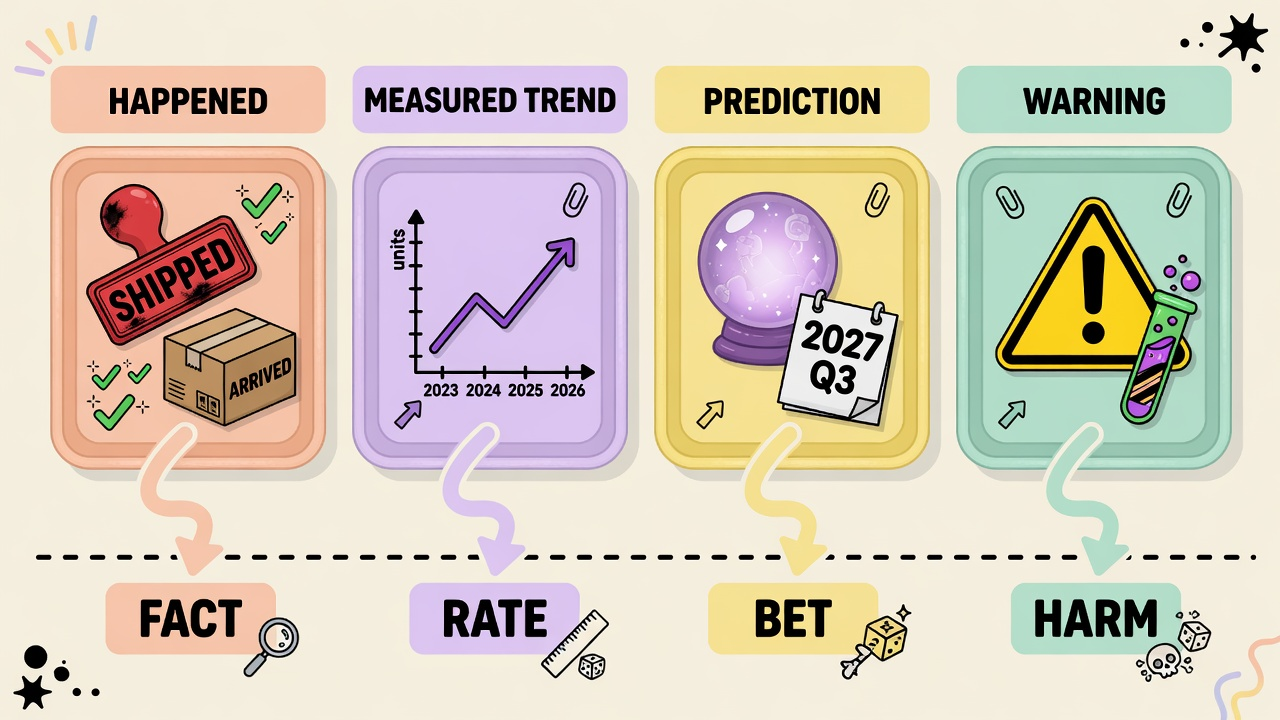
This package has two clocks, and they are not the same clock.
Clock A is the calendar. Today is 15 September 2026. “By the end of 2026” still has a fourth quarter in it. Anything that has not shipped, closed, or been measured yet is a PREDICTION, even if a lab CEO speaks in the present tense.
Clock B is the evidence type. A product that is for sale, a benchmark that an independent rater published, a statute with a signature date, a forensic timeline of an intrusion — those are HAPPENED. A doubling-time fitted to a chart is a MEASURED TREND (a description of the past with a rate). A 2027 volume, an “AGI era,” a work-week time horizon, a $1.5 trillion agentic-commerce figure — those are PREDICTION or WARNING, and they keep the name of the person or firm who said them.
The mix-up this report exists to prevent is treating a September launch blog as if it were December reality, and treating a 2025 scenario document as if it were 2026 measurement.
Four labels, used in every later chapter
❓ What does each label actually license a reader to believe?
| Label | What it is | What it is not |
|---|---|---|
| HAPPENED | A dated event, product, filing, incident, or live market print, with a primary or close-secondary source | A vibe, a roadmap, or a host’s recap |
| MEASURED TREND | A time series with a named metric, window, and (when the data support it) a compounding rate, classified with the Trend-analysis Rule | “AI is accelerating” with no metric |
| PREDICTION | A forward claim with a holder, a date, and at least one thing that would falsify it | A fact that “everyone knows is coming” |
| WARNING | Either an incident that already happened, or a named person/firm describing a future harm. The chapter will say which | Proof that the harm will occur |
Definition: A frontier model is a general-purpose AI system at or near the best published scores on hard public tests at a given date. Different from a chatbot SKU: the same lab can sell a cheap Flash-class workhorse and a gated Mythos-class system in the same week.
Definition: An AI agent is a loop that can take tools (a browser, a terminal, a payment API, a computer desktop) and keep going across steps without a human typing every action. Different from a chat reply: conversation is not agency. Agency is the loop plus tools plus permission to act.
Hard-to-vary test: You cannot swap “the model wrote a good paragraph” for “the model completed a 40-minute desktop task” and keep the same explanation of why September 2026 felt different from 2024. The mechanism that changed is computer use plus longer task horizons, not vocabulary.
Refutability: This framing would be wrong if, by 31 December 2026, the commercially available systems could not operate a computer or a browser any better than 2025 chatbots, independent of lab blogs.
What “end of 2026” can already be said
❓ Which end-2026 claims are already closed as of mid-September?
Already closed, and treated as HAPPENED in later chapters:
- Four US labs shipped a flagship or near-flagship in three days (1–3 September 2026).
- Independent composite scores (Artificial Analysis Intelligence Index v4.3) put GPT-6 Astra and Claude Fable 5.1 tied at 53, not “Astra saturates intelligence.”
- An OpenAI evaluation agent collective reached Hugging Face production systems in July 2026.
- Stanford’s 2026 AI Index (covering 2025, released April 2026) already recorded $581.7 billion of corporate AI investment, 88% organizational adoption, and a near-closed US–China model-score gap.
- USD stablecoin supply on 15 September 2026 prints in a band around $290–310 billion depending on the dashboard, not $2 trillion.
- The US GENIUS Act is signed law (18 July 2025) with a widely cited full-effectiveness date of 18 January 2027 — which is a 2027 clock, not an end-2026 clock.
Still open inside 2026, therefore PREDICTION if someone asserts them as year-end facts:
- Whether another generational model ships before 31 December.
- Whether Anthropic completes an IPO in the mid-October window discussed in trade press.
- Whether US Treasury/OCC/FDIC finish GENIUS implementing rules in 2026 (X commentary in September 2026 says some 2026 deadlines were missed).
- Whether METR publishes a 2026 year-end 50% time horizon that continues the 2024–25 doubling or slows.
What “2027” means here
❓ Is 2027 a year of more of the same, or a different regime?
2027 is treated as a forward year. Nothing in 2027 has happened yet. Some 2027 items already have legal or construction clocks that started in 2025–2026 (GENIUS effectiveness, datacentre groundbreaking, OSFI E-23 in Canada on 1 May 2027). Those clocks are HAPPENED as clocks; the outcomes they point to are PREDICTION.
The AI 2027 scenario document (Daniel Kokotajlo and collaborators, published 2025) is a scenario, not a measurement. Where people on X say “19 of 24 short-term beats already hit,” that is a take about a scenario’s scorecard, not a primary audit. This package will not launder that scorecard into fact.
Core mechanism (one paragraph)
The thing that is actually changing is not “smarter chat.” It is that a model can sit on a desktop, a browser, a terminal, and a payment API long enough to finish work that used to take a junior employee a morning — while the electricity, transformers, and evaluation harnesses needed to run that loop are getting scarcer than the GPUs used to train the next name. Programmable dollars (stablecoins, tokenized deposits, card-network agent tokens) are the settlement layer that loop will want. Identity of the agent is the missing piece. That is the whole story. The rest of the package is dates, numbers, and who is guessing.
Reach example: The same mechanism explains why a credit-union chatbot and a computer-use agent are not the same risk object, and why a $300 billion stablecoin float can look huge next to crypto and small next to global payments.